By Leo Chan, Senior Packaging Consultant · November 2026
A quote brief is the set of facts you send a supplier so it can price and design custom molded pulp packaging. A usable brief has your product size, weight and fragility, how it ships, your yearly volume, the finish you want and a product sample. With those, a drawing follows in days. Without them, you get a guess, and a guess changes after the mold is cut.
The brief sets the price, and the approval steps decide whether the finished part fits. This guide covers what to send, the file formats that speed things up, how to choose wet or dry press, how to read a supplier drawing, how sample molds and prototypes work at BonitoPak in Dongguan, China, and what to sign off before production tooling starts. For the schedule and the cost numbers, we already publish a custom molded pulp packaging timeline и а guide to MOQs and tooling costs, so this article stays on the brief and the approvals.
What Does a Quote Brief Do for Your Price?
A brief lets the supplier choose the press type, the fiber, the mold size and the number of cavities, and those choices are most of the price. A thin brief forces the supplier to assume, and assumptions show up later as a revised quote. Two quotes can look far apart only because one assumed a plain tray and the other assumed a fitted, colored one.
A good brief also shortens the whole job. Every question the supplier has to ask adds a day or more of waiting. Send the answers first, and the engineers can start on the drawing the same day you write.
What Should a Custom Molded Pulp Packaging Brief Include?
Include the product, the shipping method, the volume and the finish, plus a physical sample. The table lists each item, why the supplier needs it and the form to send it in.
| Артикул | Почему это важно | Best format |
|---|---|---|
| Product size and weight | Sets pocket size, wall and depth | Length, width, height in mm or inches, weight in grams or pounds |
| Fragile points | Decides where ribs and clearance go | Photo with the weak spot marked |
| Product sample | Lets engineers check fit by hand | A real unit couriered early |
| Packing method | Sets the outer carton and stack | Carton size and units per carton |
| Shipping route | Sets humidity and drop risk | Air, sea or parcel, and the destination |
| Yearly volume and order size | Decides mold count and MOQ fit | Pieces per year and per order |
| Seen or hidden | Decides wet or dry press | Retail display or inside a shipper |
| Fiber and color | Sets look, cost and eligibility for claims | Recycled, bagasse, bamboo, white, natural, Pantone |
| Logo or emboss | Adds a mold step | Vector file and placement |
| Claims you plan to print | Limits coatings and additives | Recyclable, compostable, plastic free |
| Target launch date | Sets the plan | A date, with any hard deadline marked |
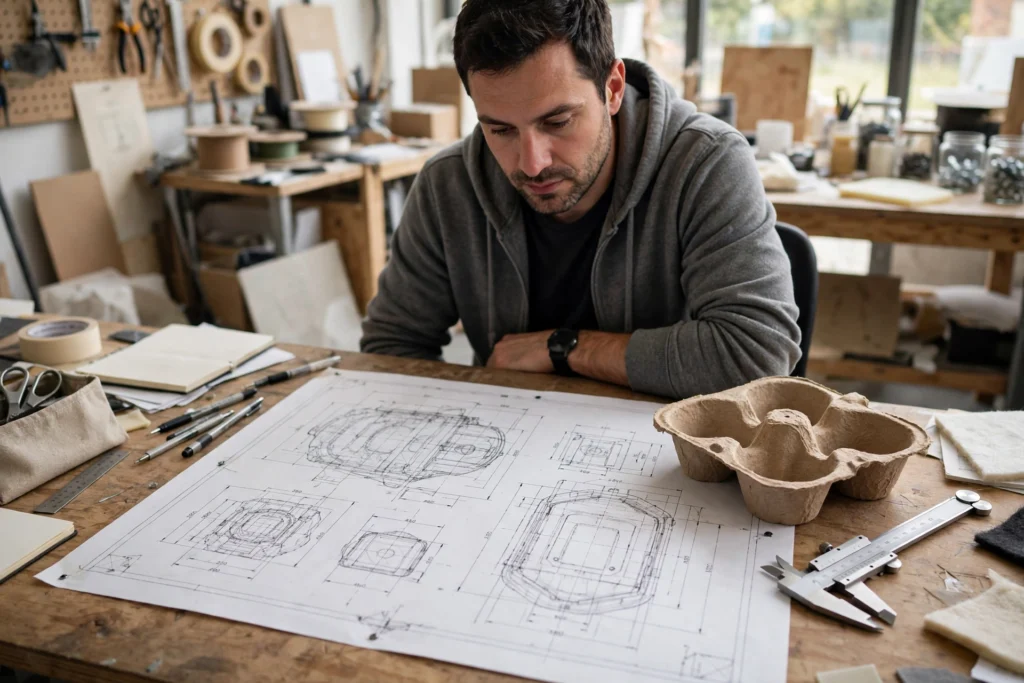
Send a physical sample if you can. For a product with a complex shape, a sample tells an engineer more than a drawing, and it also lets the supplier check how the product sits in the part before anything is made.
Do You Need a 3D File to Get a Quote?
No, but a 3D file is faster. BonitoPak works with SolidWorks, Creo, IGS and STEP files. When you send a 3D drawing, our engineers review it and respond within 24 hours. If you have no file, send the product sample, and we design from it and return a drawing in about 48 hours.
If you do send a file, check that it is the final geometry of the product and not an early version. A product revised after the mold is cut forces a mold change. Also send the packaging assembly if you have one, so we can see the carton and any other parts the tray must live with.
Wet Press or Dry Press: How Do You Say Which in the Brief?
State how the part will be seen and handled, and let the supplier recommend the press. Wet press gives a smooth, dense, sharp surface for parts that customers see. Dry press gives a rougher surface at lower cost for parts hidden inside a carton. The industry sorts molded pulp into thick wall, transfer molded, thermoformed and processed groups, as described in a review of molded pulp types, and the press type sits behind those groups.
If the tray is a retail insert that a customer opens, ask for мокрое прессование. If it is a shipping cushion that is never seen, ask for сухая глажка. If you are unsure, say so, and give both the volume and the shelf role. We will price both and show the difference.
How Do You Read a Supplier Drawing Before You Approve It?
Check the drawing against your product, not against the supplier’s word that it fits. Ask for the assembly view, with the product seated in the tray, and the carton around it. Then run through these questions.
Does the product sit with clearance on every side, or does it touch an edge that will take a drop?
Are the heaviest and most fragile points supported by a rib or a wall?
Is there room to lift the product out by hand?
Do the trays nest or stack in a way your packing line can handle?
Is there a flat area for a label or a logo?
Does the draft angle let the part release from the mold, so the walls are not too steep?
Mark each question with yes, no or ask. Send back the marked drawing. Engineers respond faster to a marked drawing than to a general comment, and changes at this stage cost nothing.
What Do a Prototype and a Sample Mold Give You?
A prototype lets you see and hold the shape, and a sample mold lets you test a real pulp part. At BonitoPak, a design file can become a simple 3D printed prototype for review. We cover the small cost of that stage. It shows form and fit, but it is not pulp, so it will not tell you about strength.
For wet pressed parts, we normally cut a sample mold first. It has one cavity and makes about 10 pieces. It is not built for mass production, because production tooling needs higher output. The reason is cost. A small change on a sample mold is cheap, while the same change on a production mold is expensive. The sample mold is not refundable. We charge only the sample mold cost, and the cost is not returned later, unlike blister tooling where the sample cost can be returned.
What Does Production Tooling Include?
A full set of wet press production tooling has one forming mold, two thermoforming molds and one die cutting mold, and some parts need a punching mold as well. Our tooling is cut by CNC from new aluminum grades #737 and #636, with copper and steel available for longer runs. Dry press molds are cheaper, because there is no thermoforming mold, and they use recycled aluminum.
Ask any supplier what is in the tooling price. A quote that lists only the forming mold may leave out the thermoforming or die cutting molds, and a quote with all of them looks higher. That one question explains many price gaps.
How Do You Test and Approve a Sample?
Test the sample as a system, with the product, the carton and your shipping conditions, then approve it in writing. Work through these steps in order.
Check the dimensions against the drawing with a caliper, and weigh five pieces.
Seat the product and check for fit, rattle and edge contact.
Place the packed product in the carton and check the carton closes without force.
Run your drop and vibration test, or a simple in-house version of it.
Leave a packed sample in the humidity your route meets and recheck it.
Check color, texture and any logo against your reference.
Record each result, with photos, and send the list back with any change request.
Change requests at this stage are small. A wall that needs a rib, a pocket that needs a few millimeters, or a corner that needs a radius can be changed on the sample mold, and the next round of pieces proves the change.
What Should the Final Approval Record Say?
The approval record names the approved sample and lists what the production part must match. Without it, a later dispute about a size or a color has nothing to settle it. Write down the sample ID, the weight, the key dimensions, the color reference and the finish.
Add the tolerances. BonitoPak die cuts flat parts to plus or minus 0.5 mm and uses a punching tool for sloped or complex parts at plus or minus 0.2 mm. Before trimming, we randomly check weight, density, strength and hardness, and every finished piece is inspected by eye for dirt, black dots, breaks, wrinkles and rough edges. Ask us to use your approved sample as the reference for these checks.
Both sides sign. Keep the approved sample, because it is the physical standard for every reorder.
How Do You Compare Quotes on Equal Terms?
Compare the same items on every quote, or the price gap means nothing. Check that each quote covers the same press type, fiber, color, cavity count, tooling set, packing method and shipping terms. Check what the sample costs and whether it is refundable. Check the MOQ and who pays for a color run. Check what happens if you change the design after the sample is approved.
Наш сайт MOQ and tooling cost guide lists the numbers behind these items, so use it as a checklist. Ask each supplier for the quote in the same layout, and ask for the mold cost and the unit price as separate lines.
How Do You Request a Quote From BonitoPak?
Email leo@bonitopak.com with the items from the table above, and attach a 3D file or ship a product sample. Say whether the tray is seen or hidden, and give your yearly volume. We review the file within 24 hours, or return a drawing from your sample in about 48 hours, and then we recommend the press type and the sample plan.
You can read how we run the four development steps on the проектирование и изготовление оснастки work, see the range of индивидуальное обслуживание options, or start from the BonitoPak homepage. Price and lead time are confirmed with each quote.
Часто задаваемые вопросы
What should I send to get a custom molded pulp quote?
A: Send product size and weight, fragile points, a physical sample, your packing method, shipping route, yearly volume and finish. A 3D file speeds up the drawing. The more you send, the less the quote changes later.
How fast do you return a drawing?
A: We review a 3D file within 24 hours. If you only have a product sample, we design from it and return a drawing in about 48 hours. Confirm the dates when you send your brief.
Why use a sample mold first?
A: A change on a sample mold costs little, while the same change on a production mold costs a lot. The sample mold makes about 10 pieces for testing, and it is not used for mass production.
Is the sample mold cost refunded?
A: No. We charge the sample mold cost only, and it is not returned later. Ask each supplier whether sample costs are refundable, since policies differ.
Do I need wet press or dry press?
A: Choose wet press for parts customers see and handle, and dry press for hidden shipping cushions. Tell us how the part is used and your volume, and we will price both.
What tolerances can I expect?
A: We die cut flat parts to plus or minus 0.5 mm and punch sloped or complex parts to plus or minus 0.2 mm. Confirm the tolerance for your part on the approval record.
About the author: Leo Chan is a Senior Packaging Consultant at BonitoPak, a molded pulp packaging manufacturer in Dongguan, China.