 Ir al contenido

The molded pulp packaging industry has evolved rapidly in recent years. What was once considered a low-cost, rough-surface alternative to plastic has now become a high-precision, premium packaging solution for electronics, food, medical, and consumer goods. At the center of this transformation is the pulp thermoforming machine.
If you are a manufacturer already familiar with molded pulp production and looking to upgrade product quality, surface finish, and dimensional accuracy, understanding pulp thermoforming is essential. This article explains what a pulp thermoforming machine is, how it works, how it differs from traditional pulp molding equipment, and where it delivers the most value in real production environments.
What Is a Pulp Thermoforming Machine?
A pulp thermoforming machine is an advanced type of molded pulp equipment designed to produce smooth, rigid, and highly precise pulp products by combining wet pulp forming with heat and pressure in a single production cycle.
Unlike conventional molded pulp machines that rely mainly on air drying or oven drying, thermoforming machines use heated matched molds. These molds simultaneously remove moisture, compress fibers, and define the final surface quality of the product. As a result, the finished packaging has a refined appearance that closely resembles plastic while remaining fully fiber-based and biodegradable.
This technology is often chosen by manufacturers producing high-value molded pulp packaging where appearance, consistency, and performance are critical.
How a Pulp Thermoforming Machine Works
The thermoforming process builds upon traditional pulp molding but introduces critical improvements at the drying and shaping stage.
First, raw materials such as recycled paper or bagasse are processed into pulp slurry. This slurry is delivered to the forming station, where vacuum suction pulls fibers onto the forming mold, creating the initial wet shape. At this stage, the product still contains a high moisture content.
The formed wet product is then transferred directly into a heated thermoforming mold. This is the most important step. Heat and pressure are applied simultaneously, allowing moisture to evaporate rapidly while compressing the fibers into a dense, smooth structure. Because drying and shaping happen at the same time, the product exits the mold fully dried and dimensionally stable.
Finally, trimming and stacking are completed, and the product is ready for packing or quality inspection. No secondary hot-pressing or long drying tunnels are required, which significantly improves production efficiency.
How Thermoforming Differs from Traditional Molded Pulp Machines
To understand why thermoforming is considered a premium technology, it’s helpful to compare it with conventional molded pulp systems.
Traditional pulp molding machines typically form the product first and then rely on air drying, oven drying, or separate hot-pressing steps. This approach works well for protective packaging such as egg trays or industrial cushioning but often results in rough surfaces, inconsistent thickness, and limited dimensional accuracy.
In contrast, a pulp thermoforming machine integrates forming and drying into a controlled, high-pressure process. This produces smoother surfaces, sharper edges, and tighter tolerances. The finished product looks cleaner and more refined, making it suitable for visible packaging and direct-to-consumer applications.
If you are still evaluating different pulp molding technologies, understanding the broader classification of molded pulp is useful. This overview of 4 tipos de pasta moldeada helps clarify where thermoformed pulp fits within the industry.
| Característica | Traditional Pulp Molding | Pulp Thermoforming Machine |
|---|---|---|
| Surface finish | Rough, fibrous | Smooth, plastic-like |
| Drying method | Hot air / long drying | Heated mold, fast cycle |
| Product precision | Medio | Alta |
| Output stability | Variable | Consistent |
| Suitable for premium packaging | ❌ | ✅ |
Key Applications of Pulp Thermoforming Machines
Pulp thermoforming machines are most commonly used in industries where both sustainability and appearance matter.
In electronics packaging, thermoformed pulp trays provide precise positioning and excellent shock absorption while maintaining a clean, professional look. Many brands use thermoformed pulp for phone accessories, earphones, and small consumer electronics.
In food packaging, thermoformed pulp containers are used for takeaway trays, lids, and compartmentalized food boxes. The smooth surface improves food contact safety and enhances consumer perception compared to traditional rough pulp products.
Medical and healthcare packaging is another important application. Thermoformed pulp trays offer consistent dimensions and stable performance, which are critical for sterilization, transport, and automated packing lines.
Cosmetics and premium retail packaging also benefit from thermoforming, where visual quality directly influences brand image.
Why Rotary Pulp Thermoforming Machines Are Widely Use
Among different thermoforming configurations, rotary pulp thermoforming machines are particularly popular in industrial-scale production.
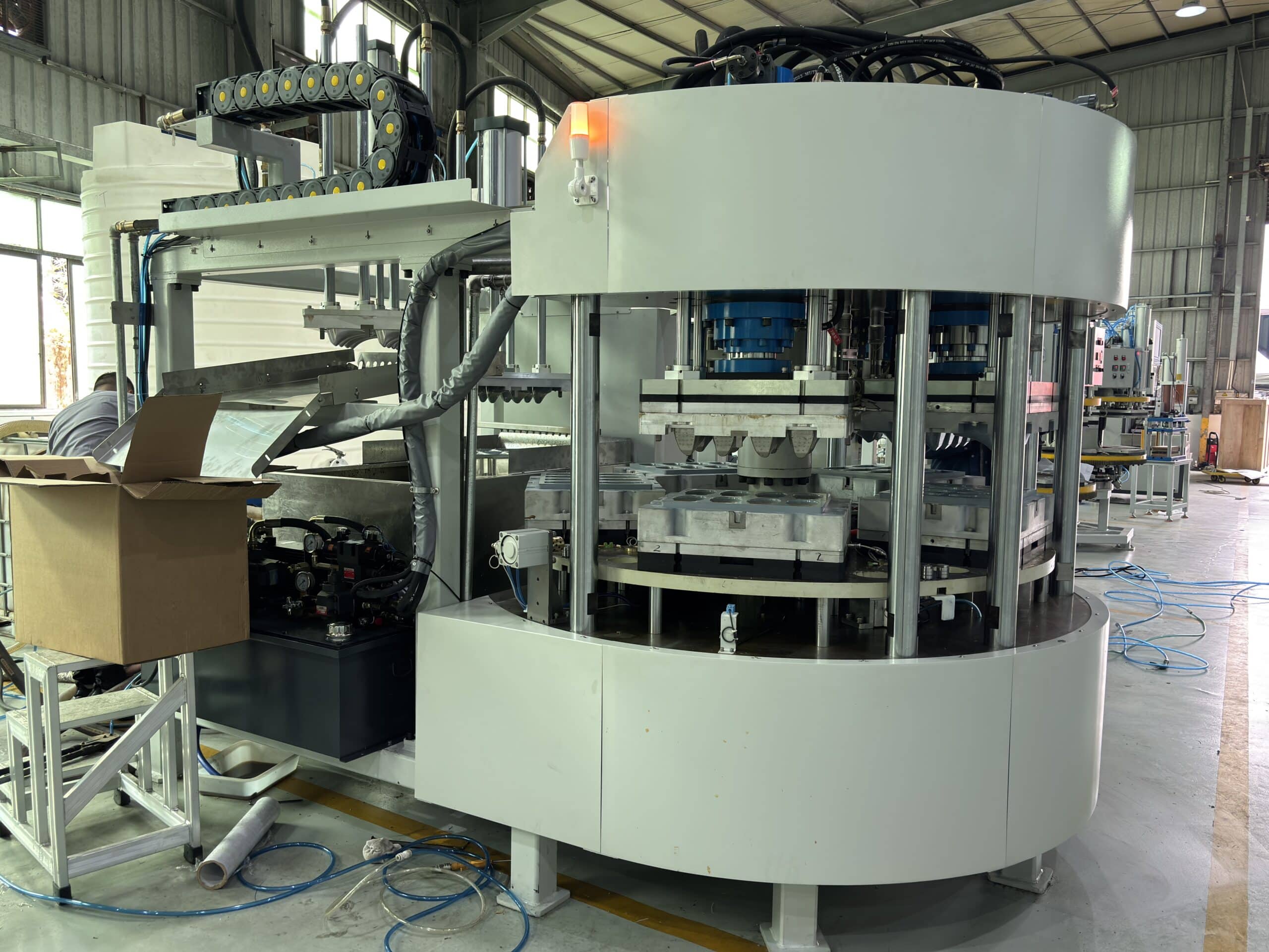
A rotary system uses multiple forming and thermoforming stations arranged on a rotating platform. This design enables continuous production rather than stop-and-go cycles. As a result, output is higher, cycle time is shorter, and product consistency is improved.
Manufacturers choose rotary systems because they offer better automation, lower labor requirements, and more stable long-term operation. A well-designed máquina termoformadora rotativa para pasta de papel can integrate forming, thermoforming, trimming, and stacking into a single production line, making it ideal for large-volume, high-quality output.
Production Efficiency, Cost, and Return on Investment
A pulp thermoforming machine requires a higher initial investment than basic molded pulp equipment. However, the return comes from product value rather than volume alone.
Thermoformed pulp products typically command higher prices due to their superior appearance and performance. They also reduce defect rates, minimize secondary processing, and lower energy consumption related to extended drying.
In real factory conditions, manufacturers often see improved production stability and fewer quality complaints. Depending on the product type and operating hours, many producers recover their investment within two to three years.
Common Mistakes When Choosing a Pulp Thermoforming Machine
One common mistake is focusing only on machine price while ignoring mold quality. In thermoforming, molds determine surface finish, thickness uniformity, and product lifespan. Poor mold design can negate the benefits of thermoforming technology.
Another mistake is underestimating technical support requirements. Thermoforming involves precise temperature and pressure control. Reliable after-sales service and spare parts availability are critical for minimizing downtime.
Finally, some buyers select machines without fully considering their target market. Thermoforming is most effective when used for products that truly require higher quality. Using it for low-margin items may limit its financial advantages.
How to Choose the Right Pulp Thermoforming Machine
Before purchasing a pulp thermoforming machine, manufacturers should clearly define their product requirements, daily output targets, and quality standards. It’s also important to evaluate whether the supplier has proven experience with thermoforming applications similar to yours.
Look for suppliers who can provide real production examples, mold customization support, and long-term technical assistance. These factors often matter more than headline machine specifications.
Conclusión
A pulp thermoforming machine represents a strategic upgrade for molded pulp manufacturers aiming to serve higher-end markets. By combining heat, pressure, and precise mold control, thermoforming delivers smooth, consistent, and premium-quality pulp packaging that meets modern sustainability and branding demands.
For manufacturers moving beyond basic molded pulp products, thermoforming is not just a technology choice—it is a competitive advantage. Exploring advanced solutions such as rotary thermoforming systems and understanding how they fit within the wider molded pulp landscape can help ensure long-term success in an increasingly demanding market.




 Spanish
  English
  German
  French
  Russian
  Japanese
  Portuguese
  Arabic