 Ir al contenido

Introduction: Why the Paper Bottle Manufacturing Industry Is Accelerating
If you’re researching a paper bottle making machine, you’re not just looking for equipment — you’re evaluating a business opportunity.
Plastic reduction regulations, ESG compliance requirements, and eco-conscious consumer behavior are reshaping global packaging. Brands in beverages, cosmetics, and household products are actively seeking fiber-based packaging alternatives. Paper bottles are no longer experimental prototypes; they are entering commercial-scale production.
However, what many investors underestimate is the technical complexity of producing paper bottles at industrial quality standards. Unlike paper cups or molded pulp trays, paper bottles must:
- Withstand liquid pressure
- Maintain structural integrity during transport
- Support internal coatings
- Provide branding-quality surface finish
This guide will walk you through the technology, machinery configuration, production workflow, costs, operational challenges, and long-term profitability potential.
1. What Is a Paper Bottle Making Machine?
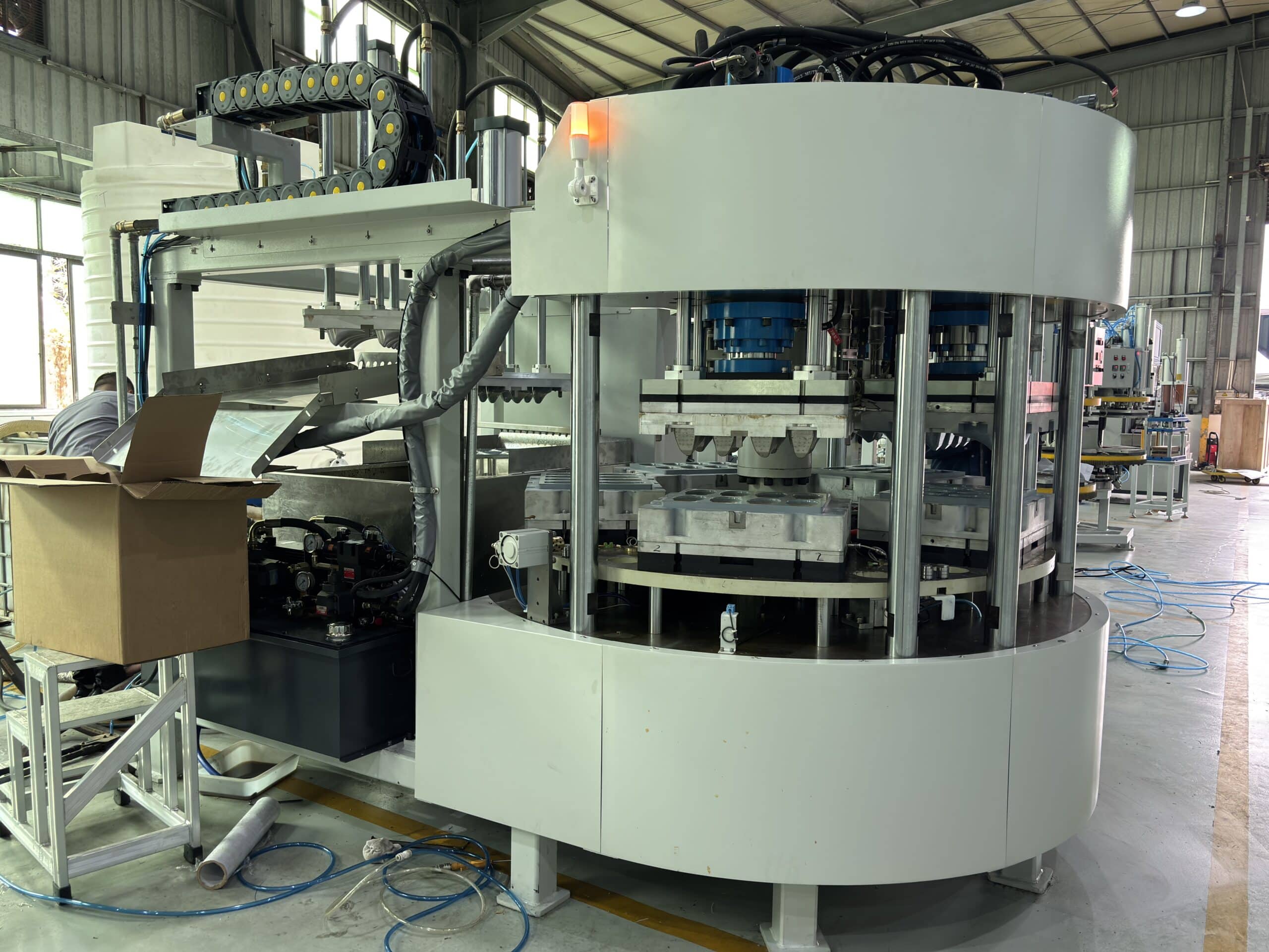
A paper bottle making machine is an integrated industrial production system designed to manufacture molded fiber or laminated paper-based bottles intended for liquid packaging.
Unlike traditional plastic bottle production, which relies on injection molding or extrusion blow molding, paper bottle manufacturing uses a molded pulp forming process combined with compression and barrier coating technologies.
The machine converts raw fiber pulp into a rigid bottle structure using:
- Vacuum forming technology
- Precision metal molds
- High-pressure pressing systems
- Controlled drying chambers
- Internal waterproof barrier application
These systems may be configured as semi-automatic or fully automatic production lines depending on scale and investment capacity.
2. How Paper Bottles Are Manufactured: Full Industrial Process
Understanding the production workflow is critical before investing in a paper bottle making machine.
Preparación de la materia prima
Production begins with fiber pulp. This can be recycled paper pulp, virgin kraft pulp, or a blended formulation depending on strength requirements. The pulp is mixed with water in a hydrapulper system and refined to achieve uniform fiber consistency.
Fiber length, pulp density, and moisture ratio directly influence bottle strength and surface finish. Advanced facilities often use automated pulp density monitoring systems to maintain consistent quality.
Vacuum Forming and Mold Shaping
The prepared pulp slurry is transferred to forming molds. Vacuum suction draws fiber onto the mold surface, creating the initial bottle shape.
This step determines:
- Wall thickness
- Structural uniformity
- Surface smoothness
Precision mold engineering is essential. Poor mold design leads to uneven thickness, weak neck structure, and dimensional inconsistency.
Hot Pressing and Structural Compression
After initial forming, the bottle undergoes high-pressure compression. This stage enhances fiber bonding and increases structural rigidity.
Industrial machines use hydraulic or servo-driven pressing systems. Pressure and temperature control must be optimized to prevent cracking or deformation.
Drying Process
Moisture removal is conducted through:
- Tunnel drying systems
- Hot air circulation chambers
- Steam-based heating systems
Drying uniformity is crucial. Uneven drying leads to warping and surface defects. High-end machines integrate temperature sensors and humidity monitoring systems to ensure stable output.
Barrier Coating Application
Paper bottles require an internal lining to resist liquid penetration. Common coatings include:
- Water-based dispersion coatings
- PLA (polylactic acid) linings
- Bio-based barrier materials
This is one of the most technically challenging steps in paper bottle production. Coating adhesion must be strong without compromising recyclability.
Final Trimming and Inspection
The bottle edges are trimmed, and quality checks are performed. Advanced production lines integrate machine vision inspection systems to detect:
- Cracks
- Uneven wall thickness
- Surface imperfections
3. Core Components of a Paper Bottle Production Line
A complete paper bottle making machine system typically includes:
- Hydrapulper and pulp preparation unit
- Forming machine with precision molds
- Hydraulic pressing unit
- Multi-layer drying system
- Internal coating application unit
- Trimming and finishing equipment
- PLC control panel
Fully automatic lines operate with minimal manual intervention, improving consistency and reducing labor dependency.
4. Technical Specifications That Determine Output Quality
When evaluating a paper bottle making machine, technical specifications matter more than price.
Capacidad de producción
Industrial machines range from 1,000 to 6,000 bottles per hour. However, actual output depends on bottle size and thickness.
Consumo de energía
Power usage typically ranges between 40 kW and 120 kW depending on heating and automation systems.
Mold Flexibility
Some machines allow interchangeable molds, enabling multiple bottle designs without purchasing a new machine.
Nivel de automatización
Modern systems use PLC control panels with touchscreen interfaces for monitoring pressure, temperature, and cycle time.
5. Types of Paper Bottle Making Machines
Semi-Automatic Machines
These require manual material handling and supervision. They are suitable for startups or small-scale production.
Líneas totalmente automáticas
These systems integrate feeding, forming, drying, and finishing into a continuous process. They reduce labor costs and increase production efficiency.
Custom Industrial Systems
Large manufacturers often invest in customized lines tailored to specific bottle dimensions and production volumes.
6. Cost Structure and Return on Investment
The cost of a paper bottle making machine depends on capacity and automation level.
- Semi-automatic units: $40,000 – $90,000
- Fully automatic lines: $150,000 – $450,000+
Additional costs include:
- Factory setup
- Electrical installation
- Raw materials
- Skilled operators
- Maintenance contracts
Assuming moderate production capacity (3,000 bottles/hour), running 8 hours daily, a facility can produce approximately 600,000 bottles monthly.
With an average net margin of $0.05–$0.10 per bottle, potential gross margin ranges from $30,000 to $60,000 monthly before expenses.
Typical ROI timeline ranges from 12 to 24 months depending on client contracts.
7. Market Demand and Industry Applications
The global packaging market is shifting toward fiber-based solutions. Paper bottles are increasingly adopted in:
- Non-carbonated beverages
- Personal care products
- Premium cosmetic packaging
- Eco-friendly brand launches
Large brands are testing fiber bottle concepts to reduce plastic dependency. This creates strong B2B supply opportunities.
8. Operational Challenges and Quality Control
Paper bottle production is not without challenges.
Maintaining consistent wall thickness requires precise pulp density control. Internal coating must provide waterproof performance without affecting recyclability. Drying cycles must be optimized to prevent warping.
Many new manufacturers underestimate these quality control complexities.
Investing in testing equipment such as compression strength testers and leakage testing systems significantly reduces defect rates.
9. How to Select a Reliable Supplier
When choosing a paper bottle making machine supplier, do not focus only on price.
Ask for:
- Production demo videos
- Client references
- Machine certification documents
- Warranty details
- Spare parts availability
If possible, arrange a live virtual inspection of the production line in operation.
A reliable supplier should provide installation training and technical support.
10. Future Innovations in Paper Bottle Technology
The next evolution in paper bottle manufacturing includes:
- Fully biodegradable barrier coatings
- Smart automation integration
- Energy-efficient drying systems
- AI-based quality inspection
As sustainability regulations tighten globally, paper bottle demand is expected to grow significantly over the next decade.
Preguntas frecuentes
Are paper bottles suitable for all liquids?
Currently, they are best suited for still beverages and cosmetic products. Carbonated drink applications are still evolving due to pressure requirements.
How durable are paper bottles?
With proper coating and compression forming, they offer sufficient durability for standard retail use.
Is skilled labor required?
Yes, especially for quality monitoring and machine calibration during initial setup.
What maintenance is required?
Monthly inspections and annual system servicing are recommended to maintain efficiency.
Conclusion: Is Investing in a Paper Bottle Making Machine Worth It?
A paper bottle making machine represents more than equipment — it represents entry into the future of sustainable packaging.
However, profitability depends on:
- Machine quality
- Process optimization
- Reliable client contracts
- Strong quality control systems
If you approach it strategically with proper planning, this industry offers significant long-term potential.
Before investing, conduct a full cost-benefit analysis, validate demand in your region, and evaluate multiple suppliers.




 Spanish
  English
  German
  French
  Russian
  Japanese
  Portuguese
  Arabic