 Ir al contenido

Industrial packaging has entered a new era. For decades, heavy machine parts, precision components, and mechanical assemblies were shipped using plastic foam, thermocol, or bulky wooden supports. These materials were cheap, familiar, and widely available — but they came with major drawbacks: poor sustainability, increasing disposal costs, and growing regulatory pressure against non-recyclable packaging.
That shift is exactly why more manufacturers are now searching for solutions like pulp moulding machinery and roll cradles for machine parts.
This is not a casual keyword. It reflects a very specific industrial need: how to produce molded fiber cradles and protective packaging inserts strong enough to support heavy cylindrical parts, rollers, shafts, and sensitive machine components during storage and transport.
In this guide, we will explore what pulp moulding machinery is, how roll cradles are produced, why molded fiber is becoming the preferred packaging choice for machine parts, and what businesses need to consider before investing in this type of equipment.
Understanding Pulp Moulding Machinery in Industrial Applications
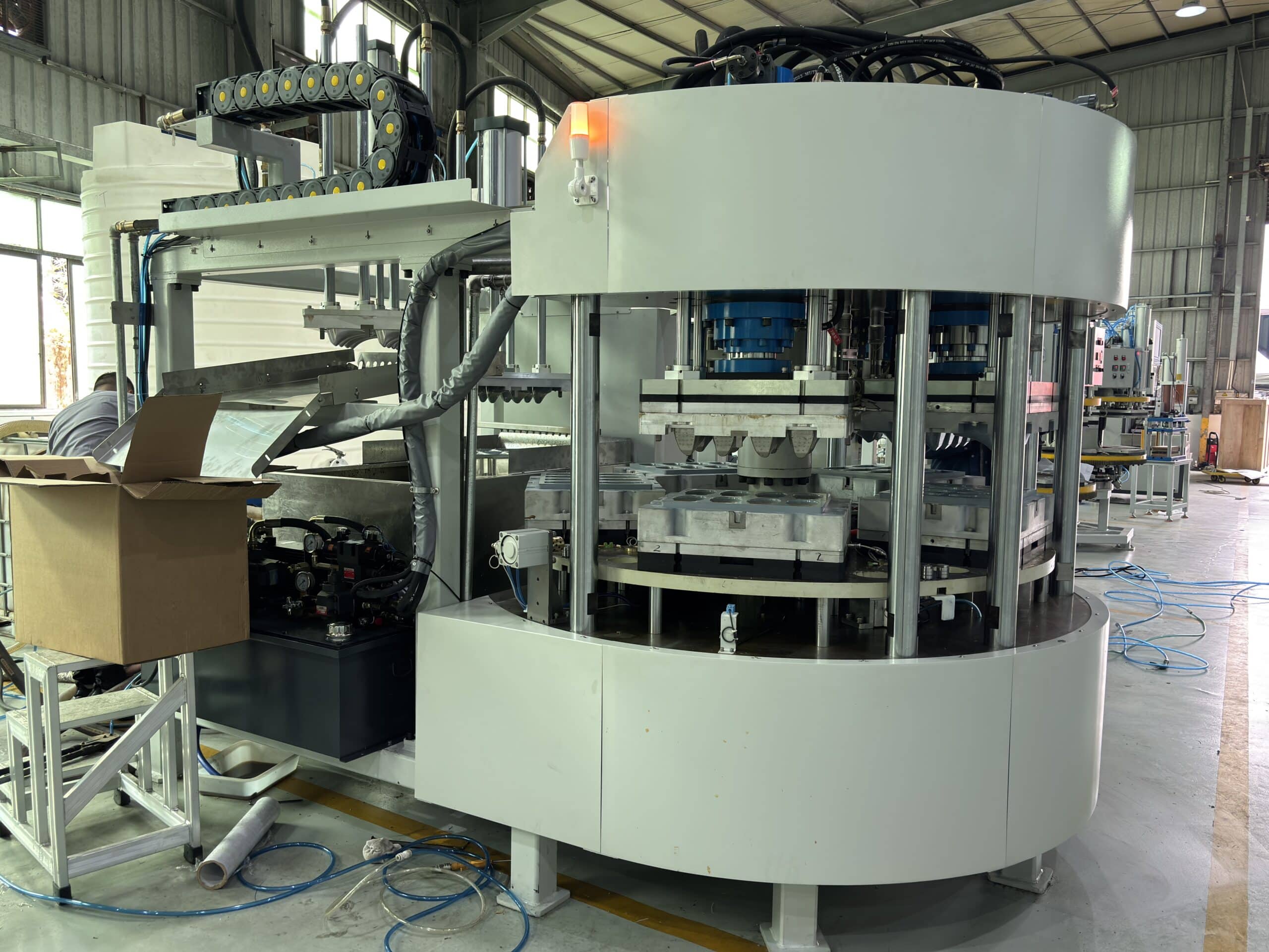
Pulp moulding machinery refers to manufacturing systems that convert recycled paper pulp into rigid molded fiber shapes. While many people associate pulp molding with egg trays or disposable food packaging, industrial pulp moulding is a much more advanced and high-value segment.
In industrial contexts, pulp moulding machines are used to create protective packaging components designed for durability, impact resistance, and precise part-holding geometry. These molded fiber products are engineered not for light consumer goods, but for demanding applications such as automotive parts, machinery assemblies, electrical components, and heavy industrial rollers.
What makes pulp moulding particularly valuable is its ability to form custom-fitted shapes that protect machine parts without relying on plastic-based foam or expensive wooden fixtures. When designed correctly, molded fiber packaging can absorb shock, prevent movement, reduce surface abrasion, and provide stable cradling for cylindrical or irregular parts.
What Are Roll Cradles for Machine Parts?
Roll cradles are specialized molded supports designed to hold cylindrical machine components securely in place. These are commonly required for items such as:
- Industrial rollers used in printing or textile machinery
- Steel shafts and pipe components
- Motor housings and mechanical assemblies
- Precision-machined parts that cannot shift during shipping
The purpose of a roll cradle is not only to “hold” a part, but to prevent rolling, vibration damage, edge impact, and misalignment during transport.
Traditionally, companies used foam blocks or wooden frames for this purpose. However, these materials are increasingly being replaced by molded fiber roll cradles because pulp-based packaging is recyclable, stackable, cost-efficient at scale, and easier to dispose of in global supply chains.
The growing demand for roll cradles is one of the strongest indicators that pulp moulding machinery is no longer just for food or agriculture — it is becoming an industrial packaging standard.
Why Molded Fiber Packaging Is Replacing Foam and Plastic in Machine Parts Shipping
The shift toward molded pulp roll cradles is driven by several real-world industrial pressures.
First, sustainability is no longer optional. Many manufacturers supplying international OEMs must comply with strict environmental packaging requirements. Foam packaging is increasingly viewed as outdated because it is difficult to recycle and expensive to dispose of, especially in Europe and other regulated markets.
Second, molded fiber cradles offer excellent shock absorption. Properly engineered pulp packaging distributes load evenly and reduces concentrated stress points, which is critical when transporting heavy components that can deform or crack if poorly supported.
Third, pulp molded packaging improves warehouse and logistics efficiency. Roll cradles can be designed to nest, stack, and optimize container space, reducing freight costs and improving handling safety.
Finally, molded pulp solutions enhance brand credibility. Industrial buyers and global clients increasingly associate molded fiber packaging with modern, responsible manufacturing practices.
In my experience observing packaging transitions in industrial supply chains, molded fiber adoption often begins as a compliance requirement — but quickly becomes a cost and efficiency advantage once companies scale production.
How Pulp Moulding Machinery Produces Roll Cradles
The production of roll cradles for machine parts involves the same core pulp molding process, but with higher precision and stronger structural requirements.
The process begins with pulp preparation. Recycled paper is mixed with water and processed into a consistent slurry. For industrial packaging, manufacturers often use stronger fiber blends, sometimes adding reinforcing pulp grades to increase rigidity.
Once the pulp is prepared, the forming stage begins. Vacuum suction draws the fiber onto a specially designed cradle mold. Unlike simple egg tray molds, roll cradle molds must achieve precise geometry, thickness control, and load-bearing strength.
After forming, the wet cradle must be transferred carefully for drying. Drying is one of the most critical stages because industrial cradles must maintain dimensional accuracy. Warping or uneven shrinkage can compromise part fit.
Most industrial roll cradle production requires controlled drying systems rather than natural drying. Hot air chambers or automated drying tunnels are commonly used to ensure consistent moisture removal.
For premium machine-part packaging, hot pressing is often applied. Hot pressing densifies the molded fiber, increases surface smoothness, and significantly improves strength. This is especially important when packaging precision-machined rollers that cannot tolerate surface scratches or movement.
Comparison Table: Machinery Types for Industrial Roll Cradle Production
Different pulp moulding machinery configurations offer different performance levels depending on automation and product complexity.
| Machinery Type | Suitable for Roll Cradles? | Output Capacity | Best Use Case | Strength Level |
|---|---|---|---|---|
| Manual/Semi-Manual Machines | Limitado | Bajo | Prototype or small batch cradles | Moderado |
| Semi-Automatic Industrial Machines | Sí | Medio | Regional industrial packaging supply | Alta |
| Fully Automatic Pulp Moulding Lines | Excelente | Alta | Large OEM packaging production | Muy alta |
| Hot Press Integrated Systems | Ideal for premium cradles | Medium–High | Precision machine part packaging | Maximum Strength |
One important insight is that roll cradle manufacturing is rarely successful with very basic low-cost machines. Industrial customers require repeatable quality, which usually demands better molds, stronger drying control, and often hot pressing.
Key Factors to Consider When Investing in Pulp Moulding Machinery for Machine Parts Packaging
Choosing pulp moulding machinery for roll cradles is different from choosing equipment for egg trays or disposable products. The performance requirements are much higher.
Mold design is one of the most critical investment areas. Roll cradle molds must be engineered for load-bearing support, correct curvature, and part-specific geometry. Poor mold accuracy leads to unstable packaging, which can cause shipment damage and client rejection.
Drying and finishing systems also matter greatly. Industrial packaging cannot tolerate inconsistent moisture levels or deformation. This is why controlled drying systems are often a non-negotiable requirement.
Another key factor is material strength. Many manufacturers underestimate the importance of fiber quality. Industrial molded pulp often uses higher-grade recycled fiber blends to achieve the necessary rigidity.
Finally, market demand should be confirmed before scaling production. The most successful businesses entering this niche begin with supply contracts for specific machine part packaging requirements rather than producing generic inserts without guaranteed buyers.
Common Mistakes Manufacturers Make in Industrial Pulp Packaging
A frequent mistake is assuming that industrial roll cradles can be produced with the same machinery used for agricultural trays. While the process is similar, industrial products require tighter tolerances, stronger drying control, and often pressing technology.
Another mistake is focusing only on machinery cost rather than total system cost. The full investment includes molds, drying energy, water recycling, finishing equipment, and operator training.
Some businesses also fail to test packaging performance under real shipping conditions. Roll cradles must be validated through vibration, drop, and load testing to ensure they protect parts throughout global transport.
Future Outlook: Why Roll Cradles Are a High-Growth Segment in Molded Fiber Packaging
The industrial packaging market is moving rapidly toward molded fiber solutions. As heavy manufacturing, automotive supply chains, and machinery exports expand, the demand for protective packaging that is both strong and sustainable will continue rising.
Roll cradles represent one of the most valuable product categories because they solve a specific industrial problem: safely transporting cylindrical components without plastic foam or wooden fixtures.
Manufacturers who invest early in pulp moulding machinery tailored for machine part packaging are positioning themselves in a premium niche with long-term demand stability.
FAQ: Pulp Moulding Machinery and Roll Cradles for Machine Parts
Can molded pulp roll cradles support heavy machine parts?
Yes, when designed with proper molds, strong fiber blends, and hot pressing, molded fiber cradles can support significant industrial loads.
Is pulp packaging really better than foam for machinery shipping?
In many cases, yes. Molded pulp is recyclable, stackable, and increasingly preferred by global OEMs for compliance and sustainability reasons.
Do roll cradles require hot pressing?
Not always, but hot pressing greatly improves strength, finish quality, and dimensional accuracy for precision machine components.
What industries use molded pulp roll cradles most?
Automotive suppliers, heavy machinery exporters, industrial roller manufacturers, electrical equipment producers, and OEM packaging contractors.
Conclusion: Why This Machinery Matters for the Future of Industrial Packaging
The search for pulp moulding machinery and roll cradles for machine parts reflects a major transformation happening in industrial logistics. Businesses are no longer satisfied with disposable foam and plastic-based packaging. They want solutions that are strong, engineered, sustainable, and globally acceptable.
Pulp moulding machinery offers manufacturers the ability to produce custom roll cradles that protect valuable machine components while meeting environmental standards and reducing packaging waste.
For companies looking to enter high-value molded fiber packaging, roll cradles for machine parts are one of the most promising and future-proof opportunities in the market.




 Spanish
  English
  German
  French
  Russian
  Japanese
  Portuguese
  Arabic