By Leo Chan, Senior Packaging Consultant · November 14, 2026
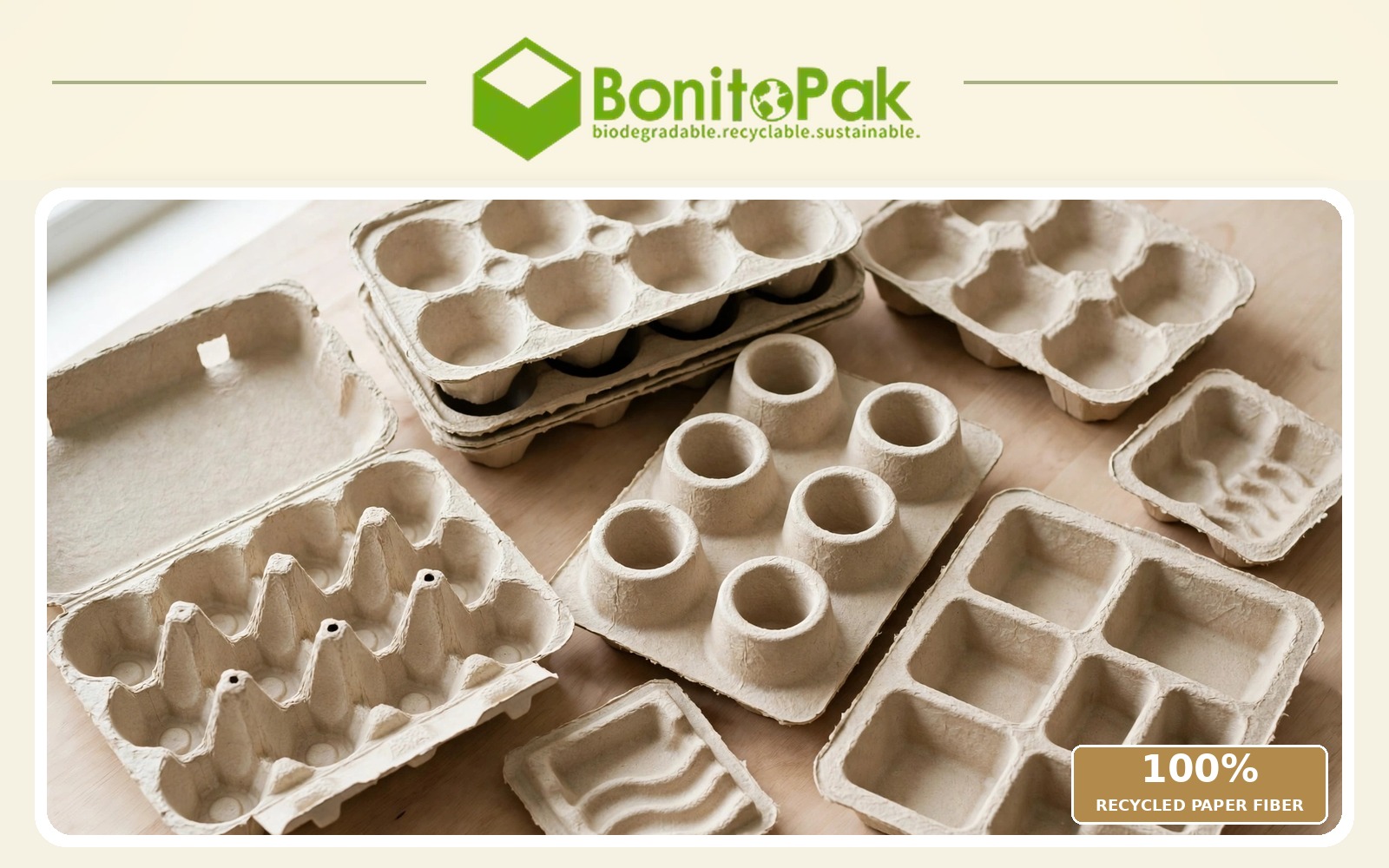
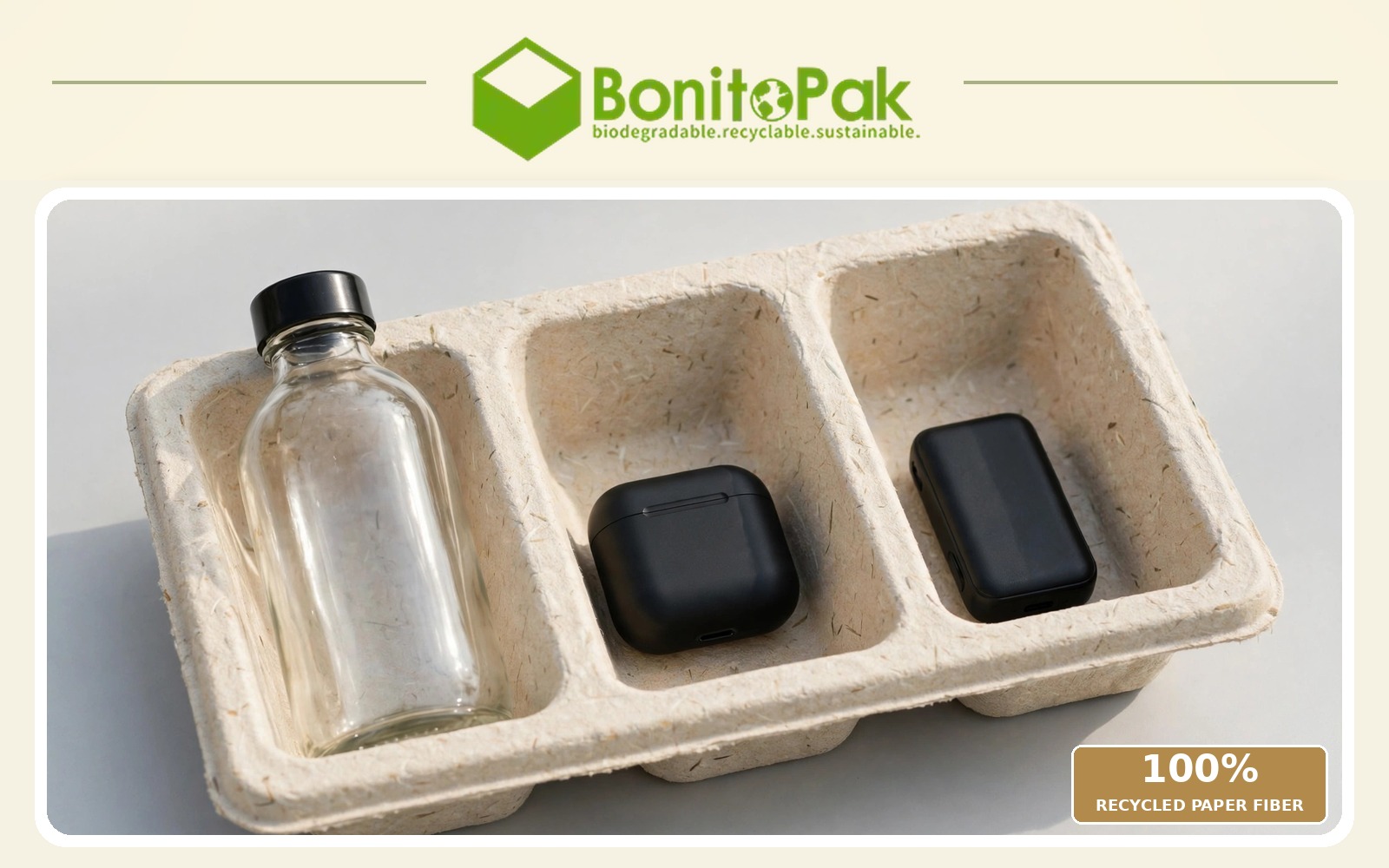
Custom molded pulp trays are fiber inserts made on a mold cut for your product, so each pocket matches its exact shape. They replace plastic and foam inserts with a sustainable packaging solution made from recycled paper or plant fiber. You pay a one-time tooling charge, approve a sample, then order in bulk at a unit price set by tray size, fiber, color and volume. At BonitoPak, MOQ starts at 1,000 pieces on most lines.
This guide is for packaging buyers who already know they want a molded fiber tray and now need to budget, quote and order one. It covers what to send for a quote, what drives tooling and unit cost, how sampling works. It also explains bulk pricing and the mistakes that add weeks to a project. Every timing and minimum below comes from our own published production data in Dongguan.
Custom trays are one part of custom pulp packaging, alongside molded pulp inserts, egg cartons and protective packaging. If you are still choosing between wet and dry pressing or picking a fiber, read our main guide to bandejas de pulpa moldeada first.
When Do You Need a Custom Molded Pulp Tray?
You need a custom molded pulp tray when no existing tool fits your product, when the tray carries a molded logo, or when the pocket must hold an unusual shape tightly. If a standard shape fits within a few millimeters, a public mold already in the factory saves the tooling charge and about a week of sampling.
Start by asking the supplier which molds they already own. We keep 65+ molds in house. Simple rectangular inserts, standard bottle trays and common device shapes can run on one of those with a small change to your outer box.
Custom tooling pays off in three cases.
Unusual product shapes. Bottles with pumps, devices with cables, or kits with five different items need pockets built around them.
Brand presence. A debossed or embossed logo is cut into the tool, so it needs a custom mold. It also lifts the unboxing experience in a way a plain stock insert cannot.
Volume. At 50,000 trays a year, the tooling cost spreads thin across every piece, and an exact fit lowers damage and returns.
What Should You Send to Get an Accurate Quote?
Send the product or an accurate 3D file and the inside size of the outer box. Add the fiber and color, the process if you know it, your annual volume and the destination market. With those six items a factory can quote tooling and unit price in days. Without them, any price is a guess.
| Send this | Why it matters for the quote |
|---|---|
| Product sample or 3D file (STEP or IGES) | Pocket shape, depth and clearance set the mold design and fiber use |
| Inside size of the outer box | Sets the tray footprint and whether it fits a standard tool |
| Fiber and color | Bagasse, bamboo, recycled or wood pulp, and natural, white, black or Pantone, all change price |
| Process, if known | Wet pressed trays cost more to tool and produce than dry pressed trays |
| Annual volume and first order size | Sets cavity count, unit price and whether bulk pricing applies |
| Mercado de destino | Decides which certificates and labels the tray needs |
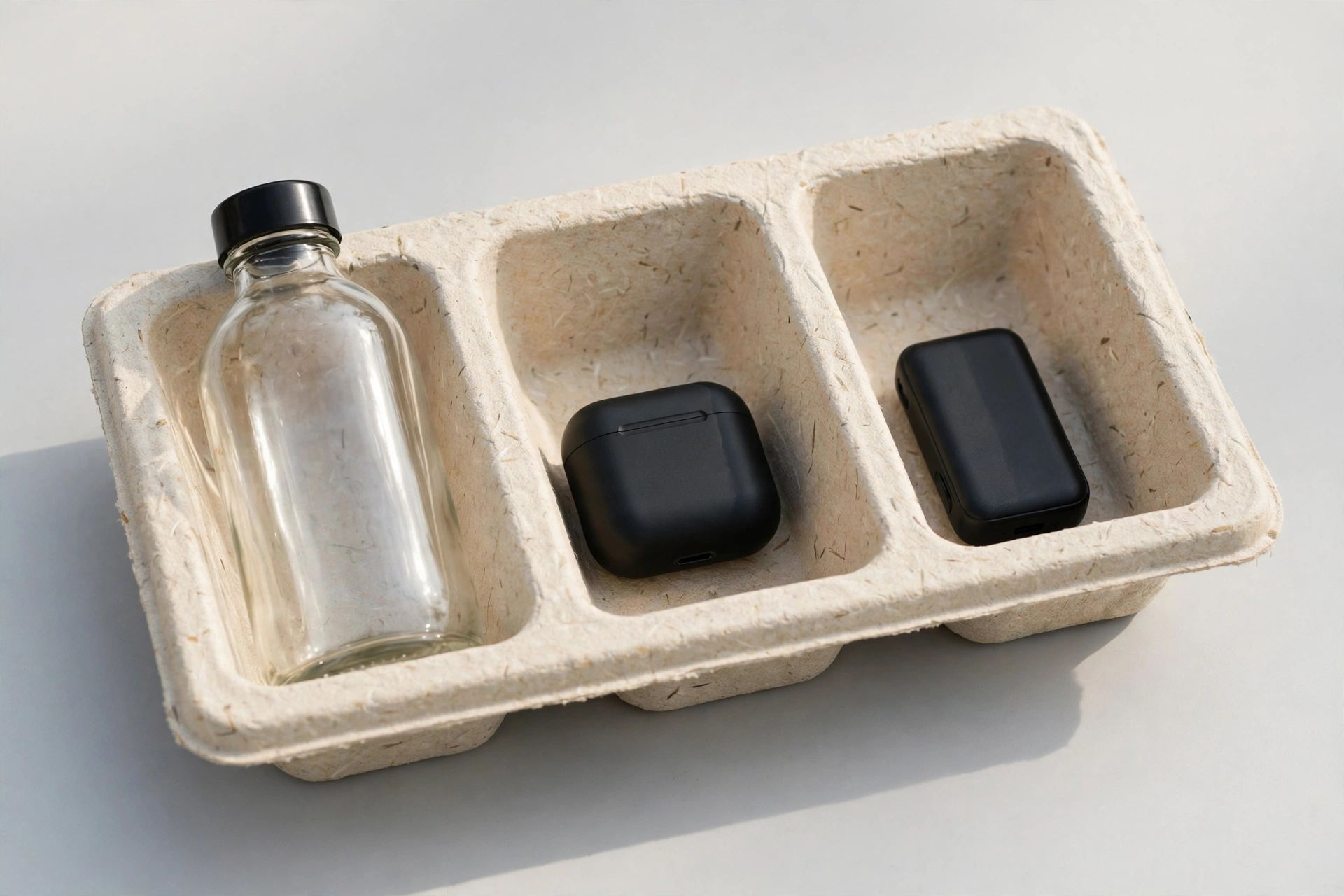
Real products beat drawings, and a physical prototype beats both. A cable that bends, a cap that sits higher than the spec, or a label that adds thickness changes the fit. We reply to inquiries within 24 hours, and a 3D drawing of your tray follows in about 2 days.
What Drives the Cost of Custom Molded Pulp Trays?
Custom molded pulp tray cost splits into one-time tooling and a per-unit price. Tooling rises with tray size, pocket complexity, cavity count and the wet press process. Unit price rises with tray size and depth, colored or white fiber, wet pressing, printing and small order volumes. Volume is the biggest lever on unit price.
Coste de los utillajes
Tooling has two parts. The sample mold (a mould, in British specs) is a single cavity tool used to make about 10 prototype pieces. It is a small charge and is not refundable, because it cannot run production. The production mold has several cavities and is the main one-time cost.
Wet pressed trays need heated matched tools, top and bottom, so their tooling costs more than a dry press forming tool. A deeper tray, more pockets, sharp details and a molded logo all add machining time to the tool.
Precio unitario
Each tray’s price comes from fiber use, press or drying time, and finishing. Bigger, deeper trays use more fiber and dry longer. White and colored fiber cost more than natural. Wet pressed trays cost more per piece than dry pressed trays of the same size because each one spends time in a heated press. Printing adds cost on every run, while a molded logo costs nothing after tooling.
How volume changes the math
Tooling is spread across every tray the mold makes.
On a 5,000 piece project, the production mold can be a large share of each tray’s cost. On a 200,000 piece project, it nearly disappears. That is why a quote with only a unit price and no tooling line is incomplete. Ask for both, and for the unit price at two or three volume levels.
Nuestra guía sobre molded pulp packaging cost, tooling and MOQ breaks this down line by line.
What Is the MOQ for Custom Molded Pulp Trays?
BonitoPak’s MOQ for custom molded pulp trays starts at 1,000 pieces on most lines. A few larger trays and specific items start at 5,000 or 10,000 pieces. The minimum follows tooling economics and how many trays fit in each mold cycle, not machine capacity. A public mold can lower both the minimum and the upfront cost.
MOQ varies widely across the industry, so check it before you spend time on design. Certain suppliers start at 10,000 pieces for every custom tray. Others quote low minimums but charge a high unit price to cover setup.
If your first order is small but your yearly volume is large, say so. A supplier can plan the cavity count around the annual figure and price the first run accordingly.
How Does the Sample Stage Work?
The sample stage turns the approved drawing into real trays you can test. We cut a single cavity sample mold and make a small run, usually about 10 pieces, in 7 to 10 days. You test fit, finish and protection with your real product in your real outer box, then approve or request changes.
Treat the sample as the most important step in the project. Here is what to check, in the same order our own quality control team uses:
Fit. Put the actual product in every pocket. It should sit snugly without force and lift out easily with the finger cutouts.
Box fit. Place the tray in the real outer box, or the full set of packaging boxes, and close it. Check that the lid does not press on the product.
Drop test. Pack the box as you will ship it and drop it from your carrier’s drop height onto corners, edges and faces.
Finish. Look at the visible face in daylight. Check the color against your brand reference and the logo depth. A high-quality wet pressed face should be smooth with no thin spots.
Small changes at this stage, such as a pocket a little deeper or a rib in a new place, cost little. The same change after production tooling is cut costs far more and takes longer.
How Are Bulk Molded Pulp Trays Ordered?
Bulk molded pulp trays are ordered after the sample is approved and the production mold is built. Production molds take 8 to 12 days on our lines. Unit price drops as volume rises, and repeat orders run on the same tool with no new tooling charge. Freight cost per tray falls because empty trays nest tightly.
Here is the full ordering sequence for a custom tray project:
- Inquiry and brief. Send the six items from the quote table. We reply within 24 hours.
- 3D drawing. Approve the CAD drawing, usually returned in about 2 days.
- Sample. Test about 10 sample trays, ready in 7 to 10 days, and approve or revise.
- Production tooling. The multi cavity production mold is built in 8 to 12 days after sample approval.
- Bulk production. Trays are formed, pressed or dried, trimmed to plus or minus 0.5 mm on flat parts, inspected and packed.
- Repeat orders. Later orders use the same tool. Only the unit price and freight apply.
Packing and freight
Tray packaging nests, so a carton holds hundreds of empty trays, which matters for high-volume production runs. That keeps ocean and air freight cost low compared with foam inserts, which ship as bulky blocks. Ask for the nested stack height and carton count per pallet when you compare quotes, because two suppliers with the same unit price can have very different landed costs.
Wholesale and stock trays
Smaller brands ask for wholesale molded pulp trays in standard shapes without custom tooling. These run on public molds. They suit startups and short runs, but the fit is generic. If your product needs a snug pocket, the custom route is worth the tooling.
Which Process and Fiber Fit a Custom Tray?
For custom trays the customer sees, choose wet pressed bagasse or bamboo, 0.7 to 1.2 mm thick, in white, natural, black or a Pantone color. For hidden inner trays, choose dry pressed recycled fiber, 1.5 to 3.0 mm thick. Both are static neutral, so both suit electronics. The process decision has the biggest effect on cost and on how well the tray meets your packaging needs.
Wet pressed custom trays. Smooth face, crisp edges and sharp logo detail. Our bandejas de pasta moldeadas por prensado en húmedo are best for phones, earbuds, cosmetics and gift sets.
Dry pressed custom trays. Thicker, rougher and cheaper to tool, with good durability under load. Best for hidden trays, appliance packaging inserts and industrial parts. Our bandejas de pasta moldeada prensada en seco use paper pulp made from recycled materials, which keeps cost and environmental impact low.
Color. Custom color is part of the tray brief. We run six pulp systems (white, natural, black, orange, gray and blue) and match Pantone colors to within about 95%. The pigment goes into the pulp, so the color runs through the whole wall.
What Mistakes Add Time and Cost to a Custom Tray Project?
Five mistakes cause most rework. Teams design from a drawing instead of the real product, measure the outside of the box, skip the sample, choose wet pressing for a hidden tray, or decide compostable claims too late. Each one leads to rework or a second mold.
Designing from a drawing. Product drawings miss real tolerances. Always send the product.
Measuring the wrong box size. The tray must fit the inside dimensions. Board thickness on a rigid box can take several millimeters from each side.
Me salto la muestra. It saves about a week and can cost a month if the production mold needs changes.
Paying for a finish nobody sees. A wet pressed face under a printed sleeve is wasted money.
Late certification decisions. Plain fiber trays are recyclable and biodegradable, so customers can recycle them with paper, but a compostable mark needs proof. If you want a compostable mark on the box, choose an uncoated fiber and confirm the certificate covers your exact tray before design. Claims on US packaging must follow the Federal Trade Commission’s Green Guides.
How Do You Compare Quotes From Tray Suppliers?
Compare quotes on the same specification: process, fiber, color, wall thickness, cavity count, sample cost, production tooling cost, unit price at two volumes, MOQ, lead time and carton packing. A low unit price with a high MOQ or no tooling line can cost more in total. Ask each supplier who builds their molds.
In-house tooling matters because every revision goes faster. An outside mold shop adds days to each change and puts a second company between you and the fix. Ask, too, whether the supplier runs both wet and dry pressing. A factory with only one process will recommend that process whether or not it suits your tray.
Nuestra envases de pulpa moldeados a medida service handles the full route, from drawing to repeat orders, with tooling built in our own workshop.
Start Your Custom Molded Pulp Tray Quote
Moving from foam to a fiber tray is an eco-friendly packaging solution your customers notice the moment they open the box. The quickest quote comes from a real product sample, the inside size of your outer box and your annual volume. Send those, plus your preferred fiber and color, and we reply within 24 hours with a process recommendation, tooling plan, sample timeline and unit price at your volume.
If you want to test the idea before investing in tooling, ask whether one of our public molds fits. For food packaging, wine packaging and other sustainable options, read our envases de pasta moldeada guide or browse the BonitoPak homepage.
Request a quote for your custom molded pulp trays today.
Preguntas frecuentes
How much do custom molded pulp trays cost?
A: Cost has two parts, one-time tooling and a unit price. Tooling depends on tray size, cavity count and process, and wet pressing costs more than dry pressing. Unit price depends on size, fiber, color and volume. Send your product size and annual volume for a real number, because any price without those is a guess.
How long does it take to make custom molded pulp trays?
A: On our lines, the 3D drawing takes about 2 days, samples take 7 to 10 days and production molds take 8 to 12 days after sample approval. Bulk production time then depends on order volume and finish. Added together, a project with one sample round reaches production tooling in about three to four weeks.
Can I order wholesale molded pulp trays without paying for a mold?
A: Yes, if a public mold the factory already owns fits your product. Public molds remove most tooling cost and shorten sampling. The fit is generic, so they work best for standard bottles and simple shapes. Products with unusual shapes or a molded logo need a custom mold.
What file format should I send for a custom tray?
A: STEP or IGES 3D files work best, along with a physical product sample if possible. A sample shows real tolerances, cable bends and labels that a file can miss. If you have no 3D file, our design team can build the tray drawing from the product itself.
Is the sample mold cost refundable?
A: No. The sample mold is a single cavity tool made only to produce test trays, so it cannot run mass production. Its cost is charged separately from the production mold. Small changes after sampling are cheap, which is why testing the sample fully saves money overall.
Do custom molded pulp trays need printing for branding?
A: No. A debossed or embossed logo is cut into the mold and appears on every tray at no extra unit cost. Printing is possible but adds a step and cost on every run. Colored pulp in your brand color is another way to brand the tray without print.