 Перейти к содержимому

The demand for molded pulp packaging has grown rapidly as manufacturers shift toward sustainable, plastic-free solutions. As production volumes increase, many factories reach a point where manual or semi-automatic equipment can no longer meet output, consistency, or labor efficiency requirements. This is where a rotary moulding machine becomes a critical consideration.
If you are evaluating production equipment for molded pulp products, understanding how a rotary moulding machine works and whether it fits your operation can save you years of costly trial and error. This guide explains the technology in depth, highlights real-world advantages, compares it with other systems, and outlines common mistakes buyers should avoid.
What Is a Rotary Moulding Machine?
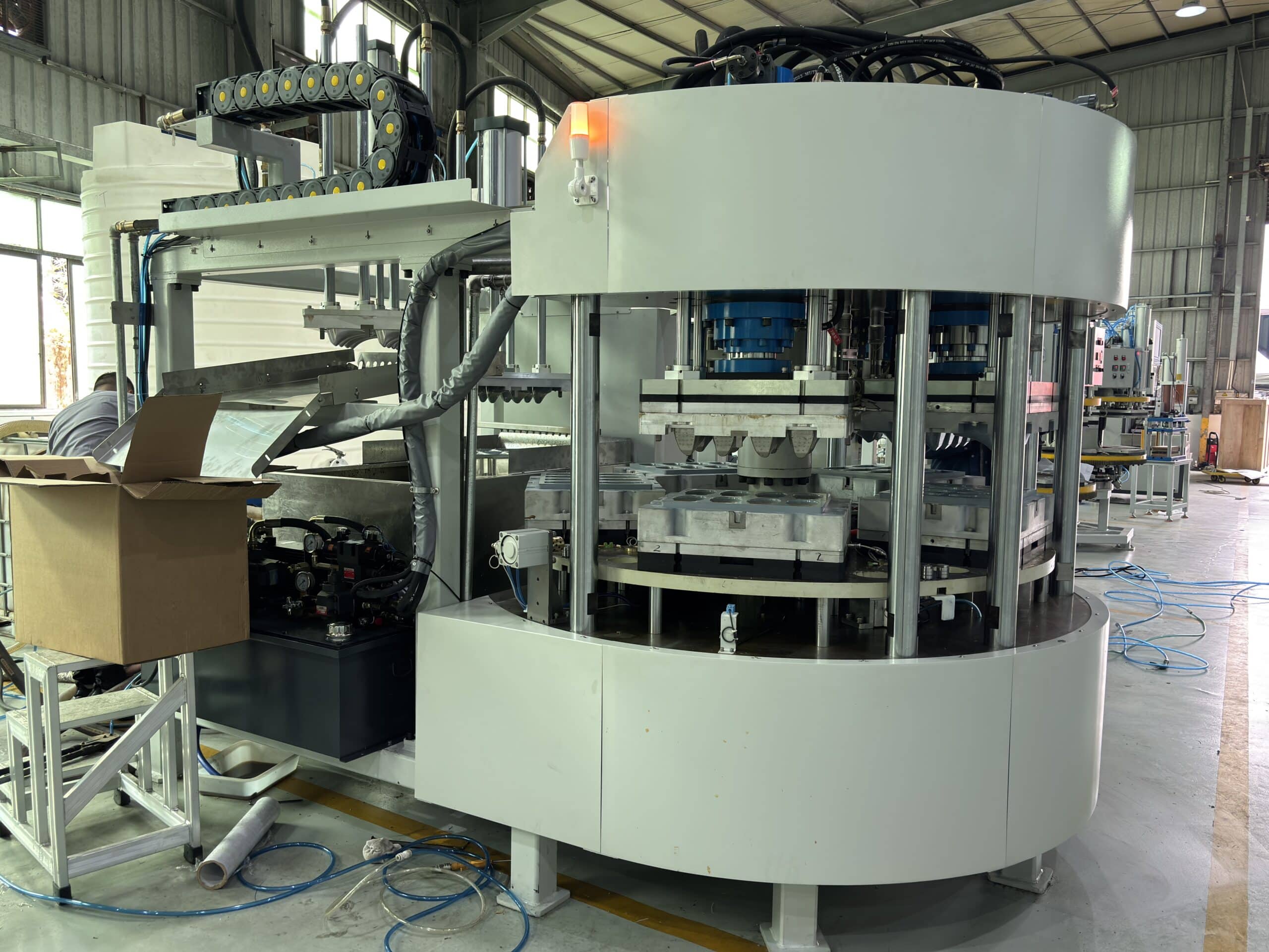
A Rotary pulp molding machine is an automated forming system in which multiple molds are mounted on a rotating drum or turntable. Instead of moving back and forth, the molds rotate continuously through different production stages, such as pulp forming, dewatering, and product release.
In molded pulp manufacturing, rotary machines are engineered specifically to handle fiber slurry, vacuum forming, and precise water removal. This makes them particularly suitable for high-volume, repeatable production of packaging items such as trays, containers, and protective inserts.
Compared to simpler reciprocating machines, rotary moulding machines are designed for factories that prioritize output stability, automation, and long-term scalability.
How a Rotary Moulding Machine Works in Molded Pulp Production
To understand why rotary moulding machines are favored in large-scale operations, it helps to look closely at the production process.
The cycle begins when a forming mold rotates into the pulp slurry tank. A controlled vacuum draws fiber onto the mold surface, creating a uniform layer. Because multiple molds are mounted on the rotating system, this forming stage happens continuously rather than intermittently.
As the mold rotates away from the slurry tank, excess water is removed through vacuum channels. This dewatering stage is critical for achieving consistent wall thickness and reducing drying time later in the process. The mold then moves to the transfer or release position, where the formed pulp product is transferred to drying, hot-pressing, or further processing.
The key advantage of this system is that forming, dewatering, and releasing occur simultaneously on different molds. This parallel workflow dramatically improves productivity and reduces idle time.
For molded pulp applications, machines such as a роторная формовочная машина для целлюлозы are specifically designed to integrate smoothly into automated production lines.
You can see an example of this technology here: https://bonitopak.com/pulp_molding_machine/rotary-pulp-molding-machine/
Why Rotary Moulding Machines Are Used for High-Volume Production
The biggest reason manufacturers invest in rotary moulding machines is production efficiency. Because the system operates continuously, output per hour is significantly higher than that of reciprocating machines with a similar footprint.
Another important benefit is product consistency. Rotary systems maintain stable forming conditions, which results in uniform fiber distribution and fewer defects. This is especially important for food packaging and export-oriented products, where dimensional accuracy and surface quality are closely monitored.
Automation also plays a major role. Rotary moulding machines reduce reliance on manual labor by automating mold movement, forming cycles, and product release. In regions where labor costs are rising or workforce availability is limited, this advantage alone can justify the investment.
Comparison: Rotary Moulding Machine vs Other Molding Systems
The table below highlights how rotary moulding machines compare with commonly used reciprocating systems in molded pulp factories.
| Характеристика | Роторная формовочная машина | Reciprocating Moulding Machine |
|---|---|---|
| Motion type | Continuous rotation | Back-and-forth movement |
| Production capacity | High, suitable for mass production | Medium to low |
| Automation level | Высокий | Умеренный |
| Labor requirement | Низкий | Выше |
| Product consistency | Very stable | Can vary with speed |
| Best application | Large-scale molded pulp production | Small or pilot-scale production |
| Initial investment | Выше | Нижний |
From a long-term perspective, rotary moulding machines are typically chosen by manufacturers who expect sustained demand growth and want to avoid frequent equipment upgrades.
Applications of Rotary Moulding Machines
Rotary moulding machines are widely used to produce a range of molded pulp products, including food packaging trays, clamshell containers, industrial protective packaging, and agricultural or medical pulp items.
Different product categories require different forming and finishing processes. For example, thin-walled food packaging demands precise vacuum control and smooth mold surfaces, while industrial packaging focuses more on strength and shock absorption.
Understanding your product type early will help you select the right rotary moulding machine configuration and avoid unnecessary customization later.
How to Choose the Right Rotary Moulding Machine
Selecting a rotary moulding machine is not just about capacity; it is about alignment with your production strategy.
Start by defining your expected daily and annual output. Rotary systems are most cost-effective when running at high utilization rates, often across multiple shifts. If your projected volume is relatively low, a simpler system may be more economical in the short term.
Next, consider mold quantity and mold quality. More molds increase output, but they also increase tooling cost and maintenance requirements. High-quality molds, however, directly impact product consistency and scrap rates.
Automation level is another critical factor. Advanced rotary moulding machines include PLC controls, adjustable vacuum systems, and automated mold cleaning. These features reduce downtime and improve long-term reliability.
Finally, evaluate how the machine will integrate with drying, hot-pressing, and packaging systems. A rotary moulding machine delivers its full value only when it is part of a well-designed production line.
Common Mistakes Buyers Make When Purchasing a Rotary Moulding Machine
One of the most common mistakes is choosing a machine based solely on initial price. Lower-cost machines may appear attractive, but they often result in higher maintenance costs, inconsistent output, and shorter service life.
Another frequent error is underestimating factory layout requirements. Rotary moulding machines require sufficient space for rotation, slurry circulation, vacuum systems, and downstream equipment. Poor layout planning can limit efficiency and make future expansion difficult.
Many buyers also overlook mold design and material quality. Even the most advanced rotary moulding machine cannot compensate for poorly designed molds. Investing in quality molds from the start reduces defects and improves overall profitability.
Finally, some manufacturers purchase high-capacity machines without a clear production plan. If demand does not materialize as expected, the machine may operate below optimal efficiency, extending the ROI period unnecessarily.
Operational Optimization and Long-Term Performance
Once installed, rotary moulding machines offer several opportunities for optimization. Adjusting vacuum levels for different products, monitoring wear on rotating components, and implementing preventive maintenance schedules can significantly improve uptime.
Factories that actively track production metrics such as output per hour, scrap rate, and energy consumption often achieve noticeable performance improvements within the first year of operation. Over time, these incremental gains can have a substantial impact on profitability.
Заключение
A Rotary pulp molding machine is a strategic investment for manufacturers aiming to scale molded pulp production efficiently and consistently. While the initial cost is higher than simpler systems, the benefits in automation, output stability, and long-term scalability often outweigh the upfront expense.
If your goal is to produce high-quality molded pulp products at volume, understanding your product type, capacity requirements, and factory layout will help you determine whether a rotary moulding machine is the right solution for your business.
Часто задаваемые вопросы
Is a rotary moulding machine suitable for small factories?
In most cases, rotary machines are better suited for medium to large-scale operations. Small factories may find reciprocating systems more cost-effective initially.
Can one rotary moulding machine produce multiple products?
Yes. With interchangeable molds and proper process control, a single machine can produce multiple molded pulp products.
How long does it take to see a return on investment?
ROI typically ranges from 18 to 36 months, depending on production volume, labor savings, and market demand.




 Russian
  English
  German
  Spanish
  French
  Japanese
  Portuguese
  Arabic