 Перейти к содержимому

Introduction: Why Rotary Systems Dominate High-Volume Manufacturing
In industrial manufacturing, speed alone does not create competitiveness. Stability, consistency, and scalability do. That is exactly why the rotary moulding machine has become a preferred solution across industries that require continuous forming, high throughput, and uniform product quality. Unlike batch-based systems that stop and start repeatedly, rotary machines operate in a circular, synchronized motion that allows production to flow continuously.
For manufacturers producing molded fiber products, packaging components, food products, or shaped materials at scale, the rotary moulding machine offers a structural advantage. It reduces downtime between cycles, improves material consistency, and supports predictable output. However, like any industrial equipment, performance depends heavily on design integration rather than the nameplate alone.
Understanding how a rotary moulding machine works — and when it is the right choice — is critical before making a capital investment.
What a Rotary Moulding Machine Actually Does
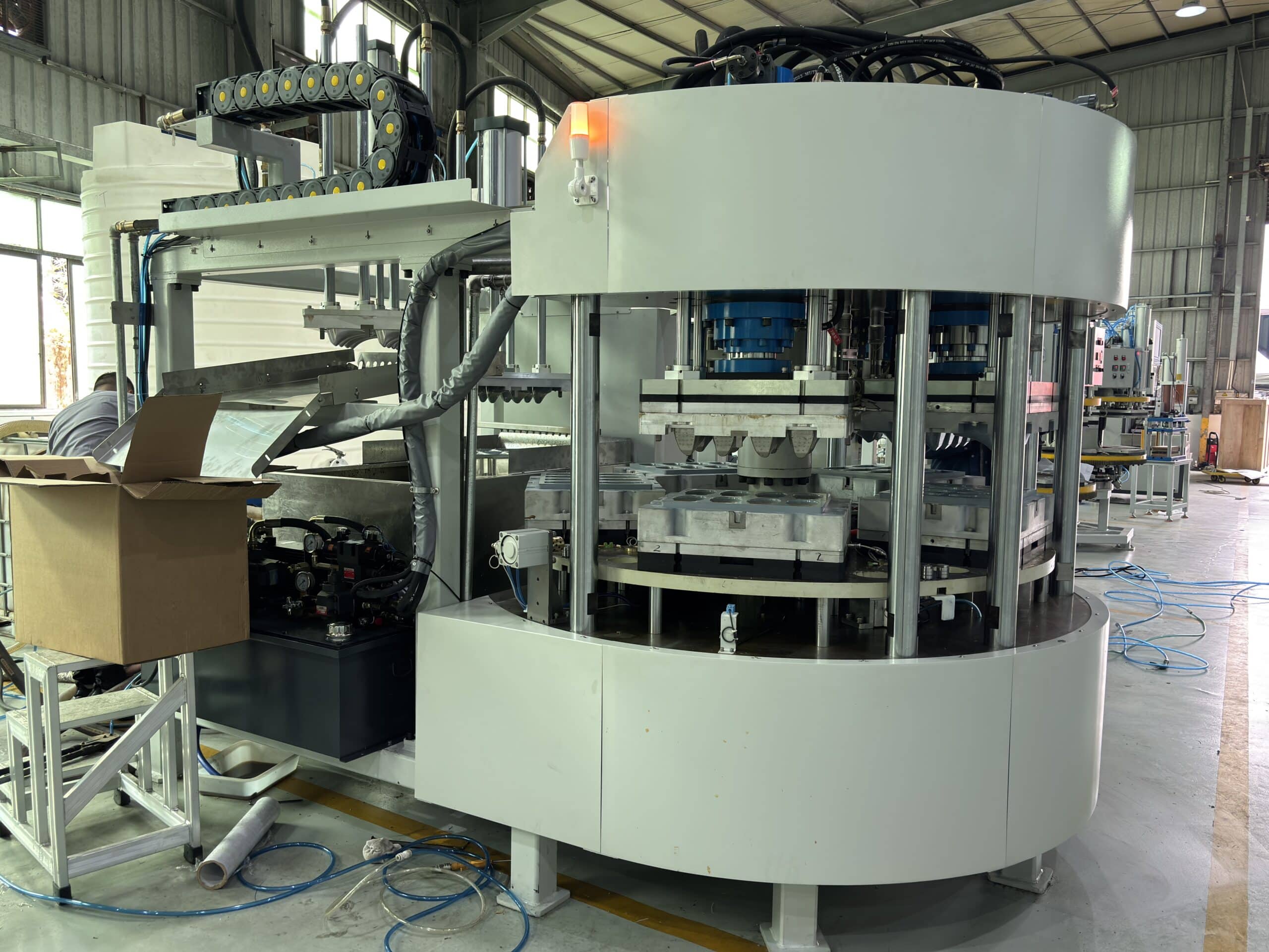
A rotary moulding machine operates on a rotating platform or drum system where molds move through sequential stages of forming, pressing, drying, or cooling. Instead of a single mold cycling independently, multiple molds rotate continuously through each phase of production. This configuration allows simultaneous processing steps, increasing efficiency and reducing idle time.
In molded fiber applications, for example, pulp slurry is deposited onto molds during rotation. Excess water is removed through vacuum systems. The partially formed product continues rotating into pressing and drying zones before being ejected. The continuous motion creates a smooth production rhythm that batch systems struggle to achieve.
This type of configuration is particularly effective in molded packaging production, where consistent shape and density are essential. Similar production logic applies in advanced molded fiber systems such as Лотки для формованной целлюлозы сухого прессования, where synchronized forming and pressing improve product strength and dimensional stability.
The principle is simple: continuous motion reduces inefficiency.
Where Rotary Moulding Machines Are Used
Rotary moulding machines are widely used in molded fiber packaging, food processing equipment, plastic rotational molding, and certain composite forming systems. In fiber-based manufacturing, they are especially valuable for high-volume production of trays, clamshell containers, protective inserts, and industrial packaging components.
The advantage lies in cycle time reduction. Because molds rotate through stages without stopping the entire system, throughput increases while maintaining consistency. This is particularly important for manufacturers supplying large retail or industrial clients who require stable quality across thousands or millions of units.
However, success depends on how well forming, vacuum, pressing, and drying are balanced within the rotary sequence.
Energy and Efficiency in Rotary Systems
Energy efficiency in a rotary moulding machine depends on synchronized stage design. Because multiple molds are in motion simultaneously, energy loads are distributed across forming, vacuum, heating, and mechanical rotation systems.
In a typical molded fiber rotary setup, energy use may distribute approximately as follows:
| System Area | Primary Energy Type | Approximate Share of Total Energy |
| Drying Section | Thermal | 40–50% |
| Vacuum & Forming | Electricity | 20–25% |
| Rotation Drive System | Electricity | 10–15% |
| Pressing Mechanism | Electricity | 10–15% |
Drying remains the largest energy consumer, but the advantage of a rotary moulding machine lies in cycle optimization. Because forming and drying occur in coordinated phases, moisture removal becomes more predictable. When properly engineered, rotary systems reduce thermal spikes and improve overall energy stability.
Poorly designed rotary systems, however, may suffer from uneven drying or inconsistent vacuum performance, leading to defects and increased energy waste. Integration and calibration are therefore essential.
Rotary vs Linear or Batch Moulding Systems
Manufacturers often face a choice between rotary moulding machines and linear or batch-style systems. The decision should be based on production volume, product complexity, and space availability.
| Metric | Batch/Linear System | Роторная формовочная машина |
| Production Flow | Intermittent | Continuous |
| Throughput Stability | Умеренный | Высокий |
| Cycle Time Efficiency | Нижний | Выше |
| Space Requirement | Умеренный | Compact (Circular Layout) |
| Scaling Capability | Ограниченный | Сильный |
Rotary systems generally excel in high-volume environments where continuous output is required. Batch systems may remain suitable for lower volumes or highly customized, small-run products. The wrong selection can create bottlenecks or unnecessary capital expense.
Customization and System Integration
Not all rotary moulding machines are equal. Customization plays a significant role in performance. Mold size, rotation speed, vacuum capacity, and drying temperature must align with product geometry and material behavior.
In fiber-based manufacturing, slurry composition and fiber length influence drainage characteristics. If rotation speed exceeds optimal forming conditions, wall thickness may vary. If vacuum calibration is insufficient, moisture levels remain too high entering the drying stage. These small misalignments reduce efficiency.
An integrated approach — similar to the manufacturing philosophy applied at BonitoPak — ensures that forming, drying, and rotation are engineered as a cohesive system. When mechanical motion aligns with material properties, product quality stabilizes and waste decreases.
Industry discussions around sustainable molded packaging and customization trends, such as those explored in Можно ли использовать литые целлюлозные коробки для брендирования?, highlight how precision manufacturing influences final product performance. Rotary systems support that precision when properly configured.
The Financial Perspective of Investing in Rotary Technology
From a capital expenditure standpoint, rotary moulding machines often require higher upfront investment compared to simpler batch systems. However, the long-term financial benefits frequently justify the cost.
Continuous production reduces downtime between cycles. Stable output improves contract reliability. Lower rejection rates decrease material waste. Over several years of operation, these factors combine to reduce per-unit production cost.
For manufacturers targeting large-scale distribution channels, the ability to maintain consistent quality at high volumes often outweighs the initial price difference.
The key is ensuring that the rotary system is sized appropriately for production demand. Oversized equipment operating below capacity can reduce efficiency, while undersized systems create operational stress.
Conclusion: Continuous Motion Requires Continuous Engineering
A rotary moulding machine is not simply a faster alternative to traditional systems. It is a structural shift toward continuous production logic. When properly engineered, it delivers higher throughput, improved stability, and better scalability.
However, performance depends on integration. Forming parameters must match rotation speed. Drying capacity must align with moisture removal rates. Vacuum systems must maintain uniform suction across all molds.
Manufacturers who approach rotary technology as a system rather than a standalone machine position themselves for long-term operational efficiency. Those who focus only on headline speed numbers may encounter hidden inefficiencies later.
Continuous motion works best when supported by continuous engineering discipline.
Часто задаваемые вопросы
Что такое ротационная формовочная машина?
A rotary moulding machine is a continuous production system where molds rotate through forming, pressing, and drying stages in a synchronized circular process.
What industries use rotary moulding machines?
They are widely used in molded fiber packaging, food processing, composite forming, and certain plastic molding applications.
Is a rotary moulding machine more efficient than batch systems?
For high-volume production, rotary systems typically offer higher throughput and more stable output compared to batch-based systems.
Does rotary moulding require more energy?
Not necessarily. While energy demand is distributed across multiple stages, continuous operation often improves overall efficiency when properly calibrated.
When should a manufacturer choose rotary over linear systems?
Rotary systems are best suited for consistent, high-volume production where throughput stability and scalability are priorities.




 Russian
  English
  German
  Spanish
  French
  Japanese
  Portuguese
  Arabic