 Перейти к содержимому
Автор: Лео Чан | Автор, BonitoPak | Более 20 лет опыта в сфере упаковки из формованной целлюлозы
Published: 18 August 2026 | Last reviewed: 18 August 2026
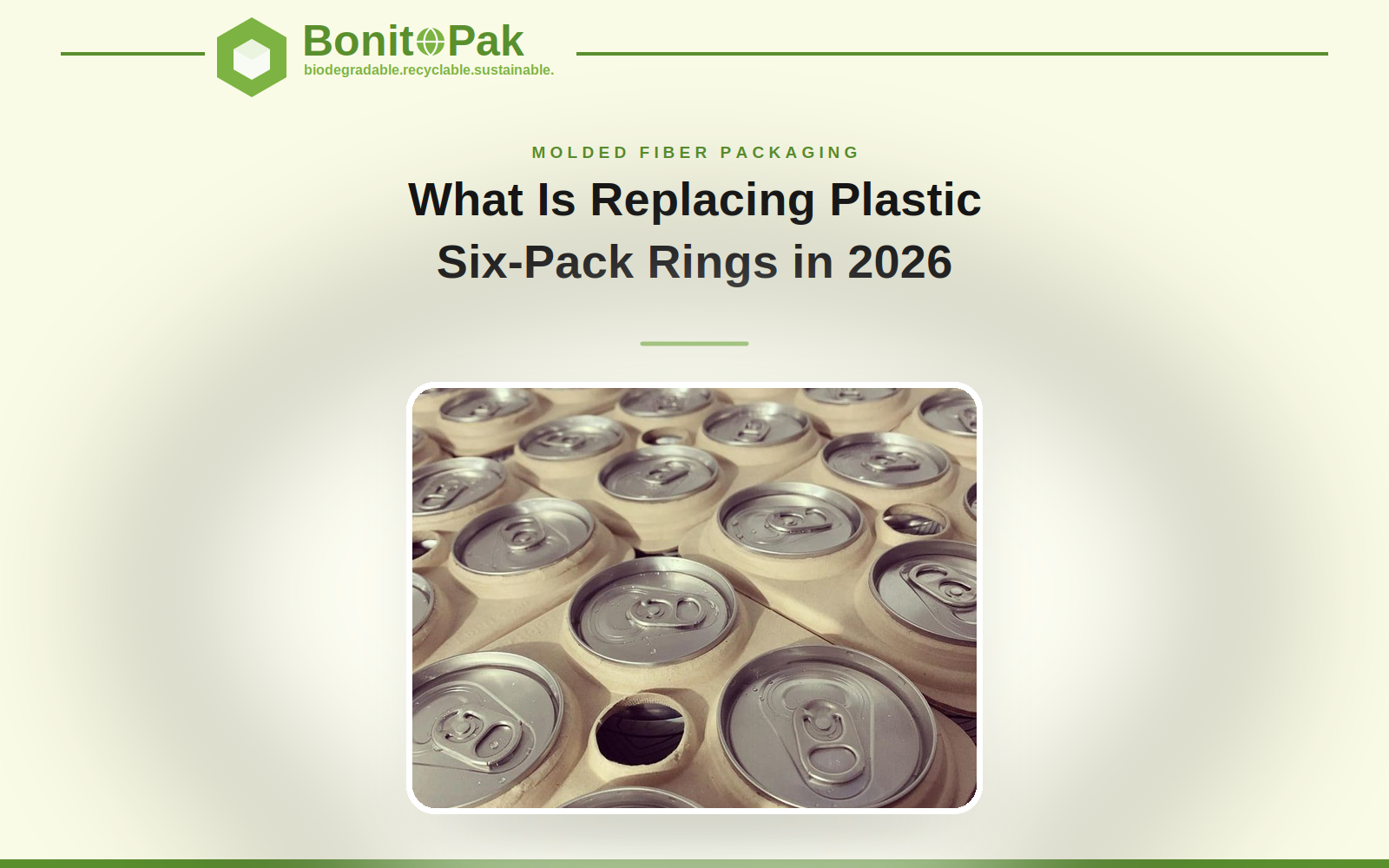
Five formats now serve as eco six pack rings: molded fiber carriers, paperboard clips and collars, rigid recycled HDPE handles, adhesive can-to-can systems, and shrink film. Regulation is shifting from degradability rules toward producer responsibility fees calculated by material weight.
Plastic six pack rings have been under pressure for fifty years, and the interesting part is that it was already fixed once. A regulatory solution arrived in the 1990s, worked as designed, and then the definition of the problem changed underneath it.
This article covers how that happened, what the rules actually say now, and what is replacing six pack rings across the market.
How the Rules Got Here
The format dates from the 1960s, when it replaced paper and metal holders. Complaints about wildlife entanglement followed within a decade, and states began legislating.
By 1990, more than 25 states had banned ring carriers that were not degradable or recyclable, and a federal mandate soon required all plastic beverage rings to be degradable. Maine had moved first, introducing a ban in 1989 before settling on looser restrictions in 1995. That history is set out by legislators revisiting the issue in more recent bills.
Photodegradable and biodegradable six pack rings were the industry answer, and they did what was asked. Exposed to sunlight the material breaks down, taking anywhere from several weeks in summer to several months in winter depending on light, temperature and weather.
For entanglement, that was a genuine improvement. A ring that fragments in a few months poses less risk than one that persists for decades.
Why Degradable Stopped Being Good Enough
The problem is that degrading is not the same as disappearing.
Photodegradation breaks plastic into progressively smaller particles. Those particles do not stop existing, they become microplastics, and they enter waterways, soil and the air. Research linking microplastics to health outcomes has moved the conversation from wildlife entanglement to human exposure, and that is a much harder argument for a material to win.
So the 1990s fix now looks like a transfer rather than a solution. It converted a visible problem into an invisible one, and legislators who accepted degradability as sufficient thirty years ago are revisiting it on different grounds.
Recycling does not rescue the format either. Rings are typically low density polyethylene, often with recycled content, but they are thin flexible film. Film is the hardest plastic category to collect, and most curbside programs exclude it. Store drop off streams exist, but participation is low enough that the practical recovery rate is close to nothing.
Where Regulation Is Actually Heading
Outright bans on plastic six pack rings remain rare in the United States. The pressure is arriving through three other routes, and they matter more.
Producer responsibility fees
Seven states have enacted packaging extended producer responsibility laws. Fees are calculated per pound of each material a producer places in that state, and rates differ sharply by material. Fiber sits at the low end and flexible plastic at the high end, often by a multiple of several times. That turns material choice into a line item rather than a values question.
The shift in 2026 is from framework to enforcement. Programs are moving past registration into active reporting, fee collection and audits, with fees tied to weight, material type and recyclability.
Labeling claims
Separately, recyclability labeling is tightening. California’s rules require unqualified recycling labels to be removed from non conforming packaging by a compliance deadline in late 2026, and other states have considered similar bills. At federal level, a proposed framework would put recyclability, compostability and reusability claims under the Federal Trade Commission and require science based third party certification, as covered in packaging policy tracking. Whether it passes or not, the direction is toward claims needing evidence.
Bans where they exist
Canada banned plastic beverage rings in 2023. Individual US states have introduced bills that would prohibit rings, shrink wrap and plastic connectors outright, and several have not passed. Treat outright prohibition as a live possibility in specific markets rather than an imminent national change.
Five Six Pack Ring Alternatives Now in Use
| Формат | Материал | Main advantage | Основное ограничение |
|---|---|---|---|
| Molded fiber carrier (eco six pack rings) | Bagasse, recycled paper, bamboo blend | Single material, compostable route | Needs water resistance engineering |
| Paperboard clip or collar | Solid bleached or recycled board | Ships flat, prints well, widely recycled | Grips the rim, not the body |
| Rigid handle carrier | Recycled HDPE | Durable, reusable, established market | Highest unit cost, remains plastic |
| Adhesive can-to-can | Adhesive only, no carrier | Eliminates the component entirely | No handle, needs line investment |
| Shrink film | LDPE film | Cheapest at volume, large print area | Worst disposal profile of the five |
Fiber carriers
Formed three dimensionally around the cans rather than gripping the top. Usually bagasse, recycled paper or a bamboo blend, and typically a single uncoated material, which keeps both recycling and composting routes open. The engineering challenge is water resistance, since the pack meets condensation. We cover the material and additive side in our article on what can carriers are made of.
Paperboard clips and collars
A flat blank folded and clipped over the can tops, or wrapped as a collar. Ships flat, prints conventionally and goes into paper recycling in most programs. The trade off is that it engages the rim rather than supporting the can body, and coated grades complicate the recycling claim.
Rigid recycled HDPE handles
Thick plastic handles clipped over the rims, molded from post consumer recycled material. Genuinely durable and reusable, with an established recycling market for the polymer. Two caveats: it is the most expensive of the five per unit, and it is still plastic, which does not satisfy a brand whose goal is plastic free packaging.
Adhesive can-to-can
Some producers have removed the carrier entirely, bonding cans directly to each other with a small adhesive dot that separates by hand. This is the only option that eliminates the component rather than substituting it, which makes it the strongest environmental position available. It also means no handle, and it requires investment in the packing line rather than just a purchasing change.
Shrink film
Heat shrunk sleeve around the whole pack. Cheap at volume with a large printable surface, and the weakest of the five on disposal, since film needs store drop off collection rather than curbside. It is usually the first format replaced when a brand reviews its packaging.
What This Means for Timing
A reasonable question is whether to move now or wait for the rules to settle. Two things argue for moving.
First, tooling takes time. A carrier format is not a purchasing decision that can be executed in a week, because cell geometry has to be cut to your specific can dimensions and validated on real product. A brand that starts when a deadline is announced is already behind one.
Second, the direction of travel is consistent even where the detail is not. Every route currently in motion, whether producer responsibility fees, labeling enforcement or outright prohibition, points the same way for thin flexible plastic. Waiting for certainty on which mechanism arrives first does not change what the answer will be.
The counter argument is real though. Switching early means committing to a format before the market settles on one, and tooling cut for a format you later abandon is a sunk cost. The way to manage that is to change material before format, since fiber will be the right material under any of these regimes even if the count or geometry changes later.
Recyclable in Theory Is Not Recyclable in Practice
This distinction is the one worth carrying into any comparison, and it applies to fiber as much as to plastic.
A material can be technically recyclable and still not get recycled, because collection infrastructure, sorting equipment and end markets all have to exist within economic distance. Rigid plastics with an established polymer market do better than film here, but consumer behavior still governs whether the item reaches the right stream.
Fiber has the same issue in a milder form, and we work through what actually happens after collection in our article on whether pulp packaging is recyclable. The honest position for any brand is to claim what happens rather than what could happen, particularly with labeling rules tightening.
Что мы видим на нашей собственной производственной линии
We form molded fiber packaging in Chashan Town, Dongguan, and switching enquiries have a recognizable shape.
A carrier is a structural part, not a tray
The most common misunderstanding is treating a carrier like a tray. A tray supports a product from underneath. A carrier holds the full loaded weight in tension while being swung one handed, and stress concentrates at the cell edges and the handle aperture. That is closer to our industrial and protective pulp packaging work than to food trays. We specify wall thickness anywhere from roughly 0.8 to 3mm, and the figure is set by loaded weight rather than by appearance.
Change one variable at a time
Brands often want to switch material and format together, moving from rings to a fiber four pack in one step. That makes any problem hard to diagnose. Matching your existing count in the new material first, then evaluating format separately, is slower on paper and faster in practice. Our wet pressing line handles customer facing finish while сухая глажка suits load bearing geometry.
Ask about the cooler before the aesthetics
The first question we ask is what the pack meets after refrigeration. A carrier that lives in consistent chilled conditions has a different specification from one that will sit in ice or move through humid ambient air. Color and finish come after that, and we run six pulp systems matched to better than 95 percent Pantone accuracy, set out on our Индивидуальная формованная упаковка из целлюлозы page. Sample molds run in about seven days with production molds around eight days after geometry approval, minimums from 1,000 pieces.
Применение этого на практике
Choose a six pack ring alternative on total cost rather than unit price. Compare the carrier cost, the line changes needed to run it, and the producer responsibility exposure per pound in every state you sell into. Fiber rates sitting well below flexible plastic rates is often the largest single difference, and it does not appear on a packaging quote.
Then be careful with claims. Say what happens to the pack rather than what could happen to it, and hold certification for anything you print. Labeling enforcement is arriving faster than material bans are, and an unqualified recyclable claim is a cheaper mistake to avoid than to correct.
На сайте BonitoPak we set fiber blend, wall section and geometry together at the tooling stage, because a carrier that fails wet or fails loaded is not a material problem but a specification one. Telling us the can format and the cold chain at quote stage gets to a workable answer faster than a target price does.
Об авторе
Leo Chan is the founder of BonitoPak and has spent more than 20 years in molded pulp packaging, working with over 500 brands moving from plastic and foam to fiber based formats. BonitoPak manufactures molded pulp packaging at its facility in Chashan Town, Dongguan, Guangdong, running both wet pressing and dry pressing lines across six pulp systems, with in house mold design and tooling. The regulatory summary here reflects published state and federal packaging policy as of mid 2026 alongside production experience on that line. Rules change frequently and should be confirmed for each market at the time of decision. This is general information rather than legal advice.
Часто задаваемые вопросы
Q: Are plastic six pack rings actually illegal in the US?
A: Not outright in most places. Older state laws require them to be degradable rather than banning them, and that requirement has largely been met. Canada took the stronger step of banning them in 2023.
Q: Why are biodegradable six pack rings still a problem?
A: Because degrading is not disappearing. Photodegradation breaks the plastic into progressively smaller fragments rather than eliminating it, which converts a visible litter problem into a microplastic one.
Q: Can I still put rings in curbside recycling?
A: Generally no. They are thin flexible film, which most curbside programs exclude. Some store drop off film streams accept them, but participation is low and the material rarely gets collected in practice.
Q: Does switching to fiber lower my compliance costs?
A: It can, where extended producer responsibility programs are active, since fees are calculated per pound by material and fiber rates sit below plastic rates. Confirm current rates for each state you sell into.
Q: What is replacing six pack rings fastest right now?
A: Matching your current count in a different material. Changing format and material together introduces two variables at once, which makes it harder to tell what caused any problem on the line.





 Russian
  English
  German
  Spanish
  French
  Japanese
  Portuguese
  Arabic