 تخطي إلى المحتوى
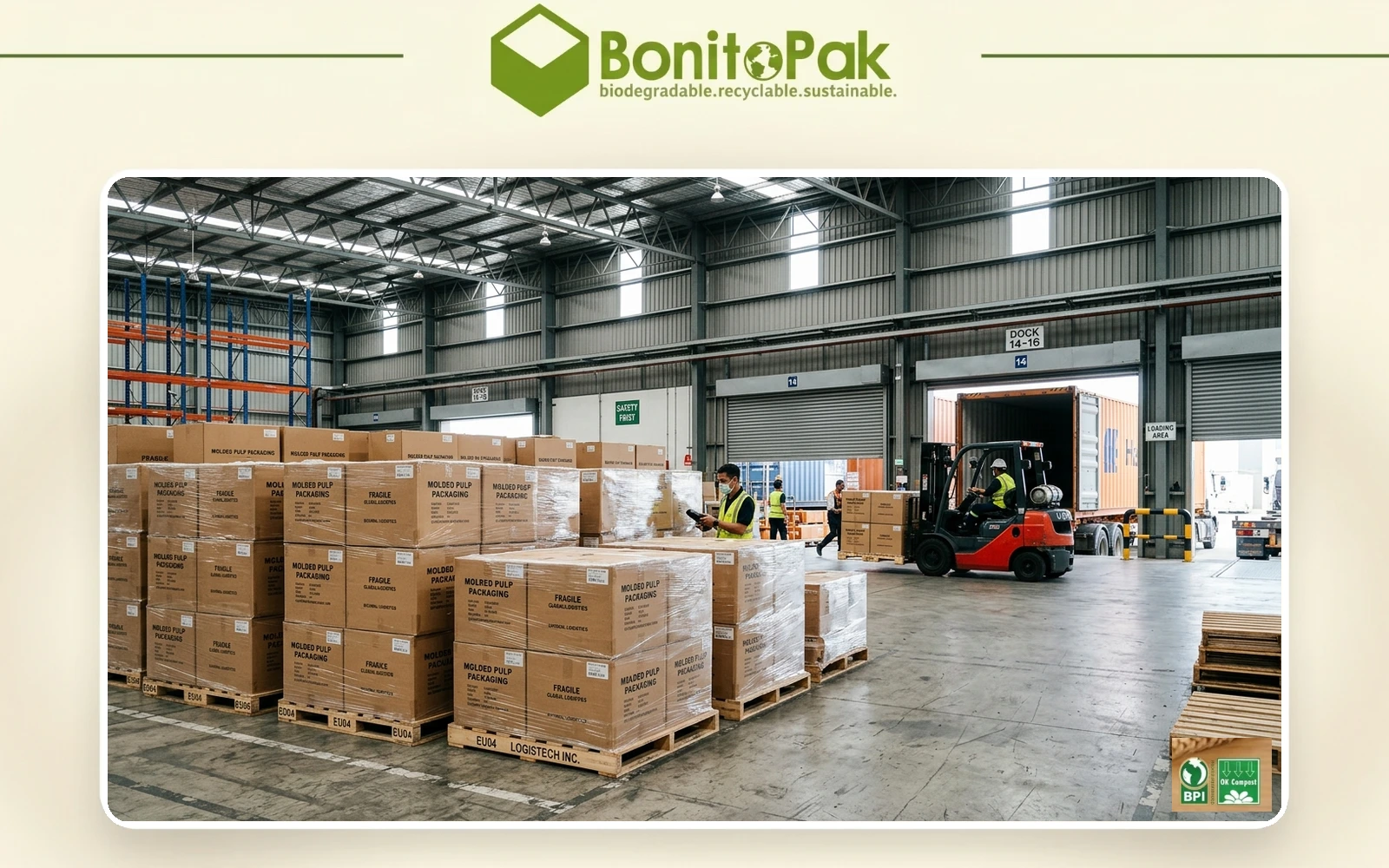
The number on a supplier’s quote is rarely what a tray actually costs you. Between the factory gate and your warehouse rack sit freight, duty, port fees, drayage, and a handful of charges that only appear on the invoice after the goods arrive.
For molded fiber specifically, the gap matters more than it does for most products, because fiber is light and bulky. Ocean freight is priced on space as much as weight, so a low unit price can be undone by a container that fills before it gets heavy. Working out the landed cost molded pulp packaging actually carries takes about an hour with a spreadsheet, and it changes purchasing decisions.
Start With the Incoterm
Every quote sits on an incoterm, and the term decides which costs are already inside the price.
| Term | Supplier covers | You cover |
|---|---|---|
| EXW (Ex Works) | Goods at the factory door | Everything, including export handling |
| FOB (Free On Board) | Goods loaded at the origin port, export cleared | Ocean freight onward |
| CIF (Cost, Insurance, Freight) | Ocean freight and insurance to your port | Duty, clearance, and inland delivery |
| DDP (Delivered Duty Paid) | Everything to your door, including duty | Receiving |
A DDP quote and an FOB quote are not comparable numbers. FOB is the most common basis for this category and the easiest to cost accurately, because you control and can see every step after the port.
Be cautious with DDP quotes that look unusually low. Ask which duty rate the supplier assumed and whether tariff changes are passed through to you. Getting that in writing avoids an uncomfortable conversation later.
The Full Cost Stack
Nine lines make up the landed cost of a shipment:
- Product cost, unit price times quantity
- الأدوات, amortized across the units it produces
- Origin charges, including export clearance, documentation, and terminal handling
- Ocean freight, the main variable
- Insurance, typically a small percentage of cargo value
- Duty, based on your HTS classification and country of origin
- Federal fees, including the merchandise processing fee and the harbor maintenance fee
- Customs brokerage and destination charges
- Drayage and inland delivery to your warehouse
Miss any one of these and your cost per unit is wrong. Miss numbers 7 and 9 and you are usually understating by more than people expect.
Freight Is About Volume, Not Weight
This is the line that catches anyone importing packaging from China for the first time.
Ocean freight is charged by container for a full container load, or by cubic meter for less than container load. Molded fiber is light, so you will almost never hit a container’s weight limit. You will fill its volume long before that.
Two things follow.
Nesting is money. Trays that nest tightly carry far more units per container than rigid non-nesting packaging. When you compare two designs, compare units per container rather than price per unit. A slightly more expensive tray that nests better can land cheaper.
Ask for units per container. Any supplier quoting molded fiber should be able to tell you how many pieces fit in a 20-foot and a 40-foot high cube container. That figure turns a freight quote into a per-unit cost in one division.
Packaging freight cost per unit = total freight and origin charges ÷ units in the container
For less than container load shipments, freight is priced per cubic meter, and LCL usually adds several days for consolidation and deconsolidation at each end.
Transit Times to Plan Around
Typical port-to-port ocean transit from South China runs about 14 to 21 days to the US West Coast and about 28 to 40 days to the East Coast. Door to door, including pickup, clearance, and inland delivery, generally runs 25 to 35 days to a West Coast destination and longer to the East Coast.
Air freight moves in roughly 3 to 7 days, but for a light, bulky product it is rarely economic. Reserve it for samples and genuine emergencies.
Duty, Tariffs, and Federal Fees
Classification Comes First
Customs duty on packaging is calculated from your HTS classification, and classification is the importer’s legal responsibility, not the supplier’s. Molded or pressed articles of paper pulp generally classify under heading 4823.70, which carries a general rate of Free for normal trade relations countries. That base rate is only part of the picture.
Additional tariffs can apply on top of the base rate depending on origin and current trade policy, and those rates have changed repeatedly in recent years. Do not plan a budget on a number you read in an article, this one included. Confirm your classification and the current applicable rates with a licensed customs broker before you commit, and ask them to flag any changes between order and arrival.
For a molded fiber part that combines materials, or one shaped as tableware rather than packaging, classification may differ. A broker ruling is worth the fee if you are importing at volume.
Federal Fees
Two fees apply to most commercial ocean imports, and they are stable enough to budget precisely.
| Fee | FY2026 rate | ينطبق على |
|---|---|---|
| Merchandise processing fee (MPF) | 0.3464% of entered value, minimum $33.58 and maximum $651.50 per formal entry | Most formal entries |
| Harbor maintenance fee (HMF) | 0.125% of cargo value, no cap | Ocean shipments only |
Entered value is the value of the merchandise, excluding duty, freight, and insurance. HMF does not apply to air or rail shipments.
The Costs That Quotes Leave Out
These are the lines that turn a good-looking landed cost into a disappointing one.
| التكلفة | Why it happens | How to control it |
|---|---|---|
| Demurrage and detention | Containers sit at the port or the equipment is returned late | Know your free days and plan collection before arrival |
| Chassis and drayage surcharges | Regional equipment shortages | Get a drayage quote for your specific delivery ZIP code |
| Warehouse receiving and unloading | Often overlooked entirely | Include your own labor or 3PL receiving cost |
| Currency movement | Quotes in USD are stable, others are not | Confirm the quoting currency and lock it if relevant |
| Payment and banking fees | Wire and letter of credit charges | Ask the bank for the full schedule |
| Failed inspection and rework | Specification set too loosely | Agree the cosmetic and dimensional spec in writing |
| Expedited freight after a delay | Missed sailing or late approval | Build buffer into the schedule rather than the budget |
Demurrage is the one that hurts most. Free time at a US port typically runs a few days, and the charges after it accrue daily per container.
A Worked Example
The figures below are illustrative arithmetic, not a quote. Substitute your own numbers.
A brand imports 40,000 custom molded fiber trays into Los Angeles on FOB terms.
| Line | Amount |
|---|---|
| Product cost, 40,000 at $0.22 | $8,800 |
| Tooling, $4,000 amortized across 100,000 units of expected first-year volume | $1,600 |
| Origin charges and export documentation | $350 |
| Ocean freight, one 40-foot high cube | $3,200 |
| Insurance | $60 |
| Duty, assuming a Free base rate and no additional tariff | $0 |
| MPF at 0.3464% of $8,800 | $33.58 (minimum applies) |
| HMF at 0.125% of $8,800 | $11 |
| Customs brokerage and destination charges | $450 |
| Drayage and inland delivery | $900 |
| Total landed cost | $15,404.58 |
| Landed cost per tray | $0.385 |
The unit price was $0.22. The landed cost is about $0.385, roughly 75% higher. That ratio is normal for a light, bulky product on its first order, and it improves on reorders once tooling is behind you. Strip the tooling line and the same shipment lands near $0.345.
Three lines carry most of the difference: freight, tooling amortization, and inland delivery. Duty happens to be the small one here, which surprises people who assume tariffs dominate. Settle your tooling charge and order quantity before you finalize this sheet, since both move the landed cost molded pulp packaging carries more than duty does.
Comparing Suppliers on the Right Basis
Once you have the stack built, comparisons get easier:
- Normalize the incoterm. Convert every quote to the same basis before comparing.
- Ask every supplier for units per container. It is the single most useful number in fiber packaging.
- Amortize tooling over the same horizon for each quote, usually one year of expected volume.
- Use the same destination. Inland cost from Los Angeles to Chicago is not the same as to Riverside.
- Compare landed cost per unit, never the factory quote.
A supplier whose trays nest better, or who quotes a lower tooling charge, can win on landed cost while losing on unit price. That only becomes visible once the stack is built.
Reducing Landed Cost Without Cutting Quality
- Design for nesting. Ask your supplier what the nesting height is and whether a small geometry change improves it. Our molded pulp insert guide covers how geometry affects protection and stacking together.
- Fill the container. Consolidate SKUs or time orders so containers ship full rather than part loaded.
- Choose the right process. Wet pressing costs more per unit, so use it where the customer sees the pack and dry pressing where they do not. Our comparison of the 4 أنواع من اللب المقولب covers where each belongs.
- Match fiber to purpose. Recycled paper costs less than bagasse or bamboo, and our materials page sets out the options.
- Order to a sensible volume. Tooling amortization falls sharply with quantity, so ordering slightly larger less often often beats small frequent orders once freight is counted.
- Plan around port congestion and holidays, so you never pay for expedited freight.
Building Your Own Cost Sheet
Set up one spreadsheet and reuse it for every quote. Rows for the nine cost lines, a cell for units per container, and a formula dividing total cost by total units. Run every supplier through the same sheet.
The exercise usually changes at least one decision. Sometimes it is the supplier. More often it is the order size or the tray geometry, because those are the levers with the most movement in them.
في بونيتوباك, we quote tooling and unit price as separate lines, provide units per container for every format, and ship from Dongguan to more than 50 countries. You can see our full range across molded pulp trays and cartons, our خدمة مخصصة options, and our مرافق التصنيع. Send us your part and your destination, and we will give you the numbers you need to build the stack.
الأسئلة الشائعة
Q: How much higher is landed cost than the factory quote? A: For light, bulky fiber packaging it is often 50% to 80% higher on a first order, driven mostly by freight, tooling amortization, and inland delivery. The gap narrows on reorders once tooling is fully absorbed.
Q: What duty applies when importing packaging from China? A: Customs duty on packaging depends on classification. Molded or pressed articles of paper pulp fall under heading 4823.70, which carries a Free base rate. Additional tariffs may apply depending on current trade policy, so confirm your classification and rates with a licensed customs broker.
Q: Why does packaging freight cost so much for molded fiber? A: Because fiber is light and bulky, so shipments fill a container’s volume long before its weight limit. Ocean freight is effectively priced on space, which makes units per container the number that matters most.
Q: Should I ask for DDP pricing to keep things simple? A: DDP is simpler to administer but harder to verify, and it hides which duty rate was assumed. FOB gives you visibility into every downstream cost. If you take DDP, get the tariff assumption and pass-through terms in writing.
Q: What is the merchandise processing fee? A: A federal fee on most formal entries, charged at 0.3464% of entered value in FY2026, with a $33.58 minimum and a $651.50 maximum per entry. Ocean shipments also pay a harbor maintenance fee of 0.125%.
About the author: Leo Chan is the founder of BonitoPak and has spent more than 20 years in molded pulp packaging, working with over 500 brands moving from plastic and foam to fiber-based formats. BonitoPak manufactures molded pulp packaging at its facility in Chashan Town, Dongguan, Guangdong, shipping to more than 50 countries. This article is general information, not customs, tax, or legal advice. Confirm classification and duty rates with a licensed customs broker.



 Arabic
  English
  German
  Spanish
  French
  Russian
  Japanese
  Portuguese