 تخطي إلى المحتوى
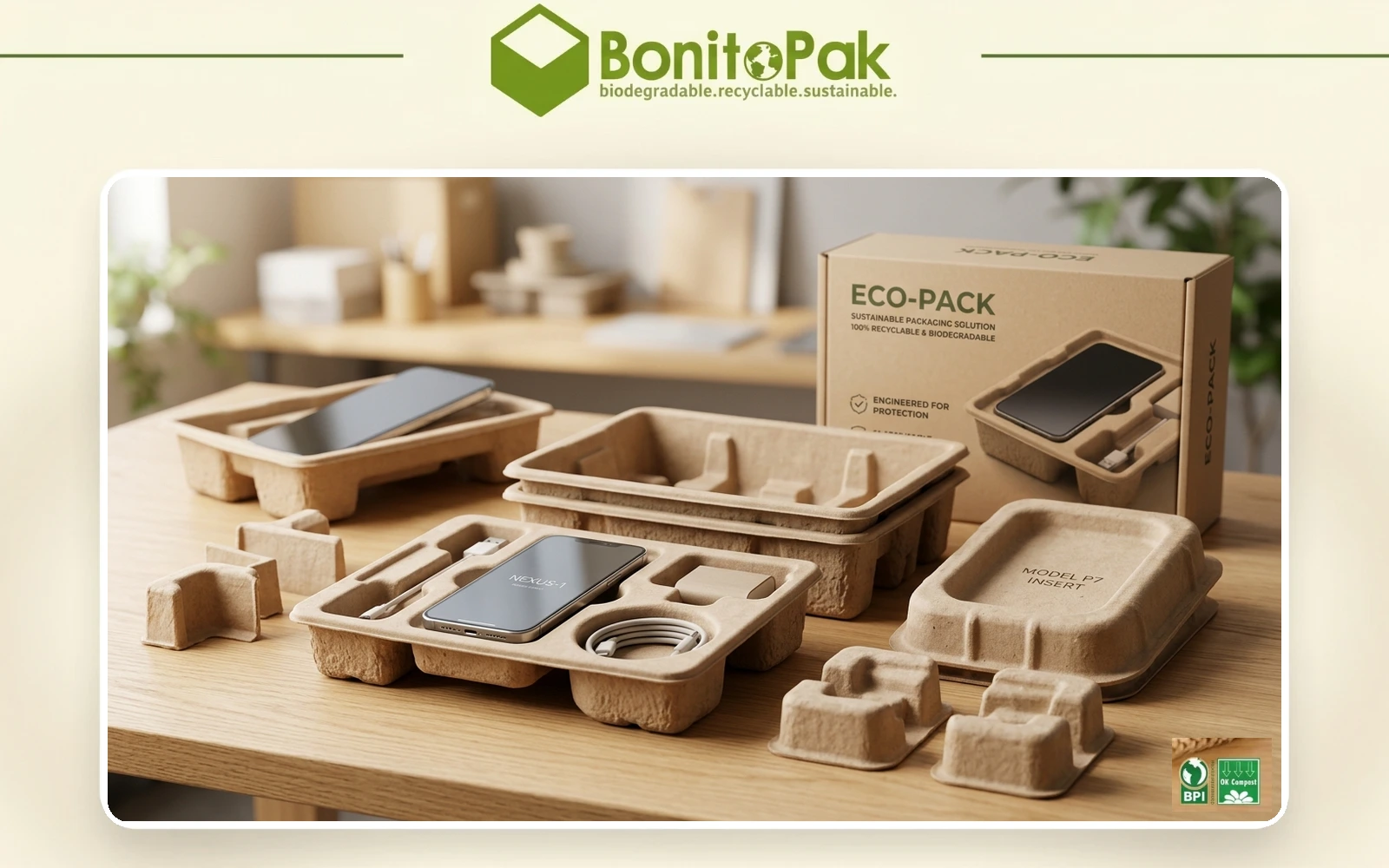
The companies that struggle with this switch usually try to change everything at once. They convert every SKU, order full volume on day one, and find out at the warehouse that the new trays do not de-nest on their pack line.
The companies that do it smoothly convert one SKU first, test it properly, and run both packs side by side until the data says the new one is better. Switching to molded pulp packaging is a project management problem more than a packaging problem, and it is entirely manageable if you sequence it correctly.
This guide sets out that sequence, along with the failure points worth planning around.
Why Companies Make the Switch
Most moves toward a sustainable packaging transition start for one of four reasons, and knowing which one is driving yours will shape how you plan it.
- Regulation. State packaging laws are tightening. California’s SB 54, whose regulations took effect May 1, 2026, calls for a 25% cut in single-use plastic packaging and for all covered packaging to be recyclable or compostable by 2032. Several other states have passed their own extended producer responsibility laws.
- Customer requirements. Retailers and enterprise buyers increasingly ask for plastic-free packaging in their supplier scorecards.
- Cost pressure. Fiber is not always cheaper per unit, but EPR fees are usually assessed by material, and plastic categories carry the heavier charges.
- Brand positioning. Fiber reads as natural on the shelf and at the unboxing, which matters for consumer-facing products.
If your driver is regulatory, work backwards from the compliance date. If it is brand-led, you have more room to pilot properly.
Step 1: Pick the Right First SKU
Do not start with your highest-volume product. Start with the one that teaches you the most for the least risk.
A good pilot SKU has:
- Moderate volume, enough to be meaningful but small enough to absorb a mistake
- A simple shape, without deep undercuts or fragile protrusions
- A stable design that is not about to be redesigned
- A delivery route you can observe end to end
- A packing operation you control, rather than a co-packer’s line
Avoid your most fragile product, your newest launch, and anything with a hard seasonal deadline. Those come later, once the process is proven.
Step 2: Match the Process to the Job
This decision comes before any drawing, because it sets your tooling and your unit cost.
| Your current pack | Usual fiber equivalent | Why |
|---|---|---|
| EPS foam end caps and corner blocks | Dry pressed molded fiber | Thick walls give comparable cushioning when you replace foam packaging |
| PET clamshell on a retail shelf | Wet pressed molded fiber | Smooth faces and crisp detail for display |
| Vacuum-formed insert inside a box | Dry pressed molded fiber | Hidden part, so finish does not matter |
| Foam trays for electronics in retail boxes | Wet pressed molded fiber | Tight fit and clean presentation |
| Blister packs | Often a hybrid or a redesign | Fiber cannot replicate transparency |
Our comparison of the 4 أنواع من اللب المقولب covers what separates the processes, and our molded pulp insert guide goes deeper on fitted inserts specifically.
One honest limitation: fiber is opaque. If your pack depends on the customer seeing the product through the packaging, plan for a window, a redesign, or a different SKU to pilot.
Redesign, Do Not Copy
The most common technical error in a plastic to molded pulp transition is handing over the plastic part and asking for it in fiber. Vacuum-formed plastic holds shapes that fiber cannot, including sharp internal corners, zero draft walls, and very thin sections.
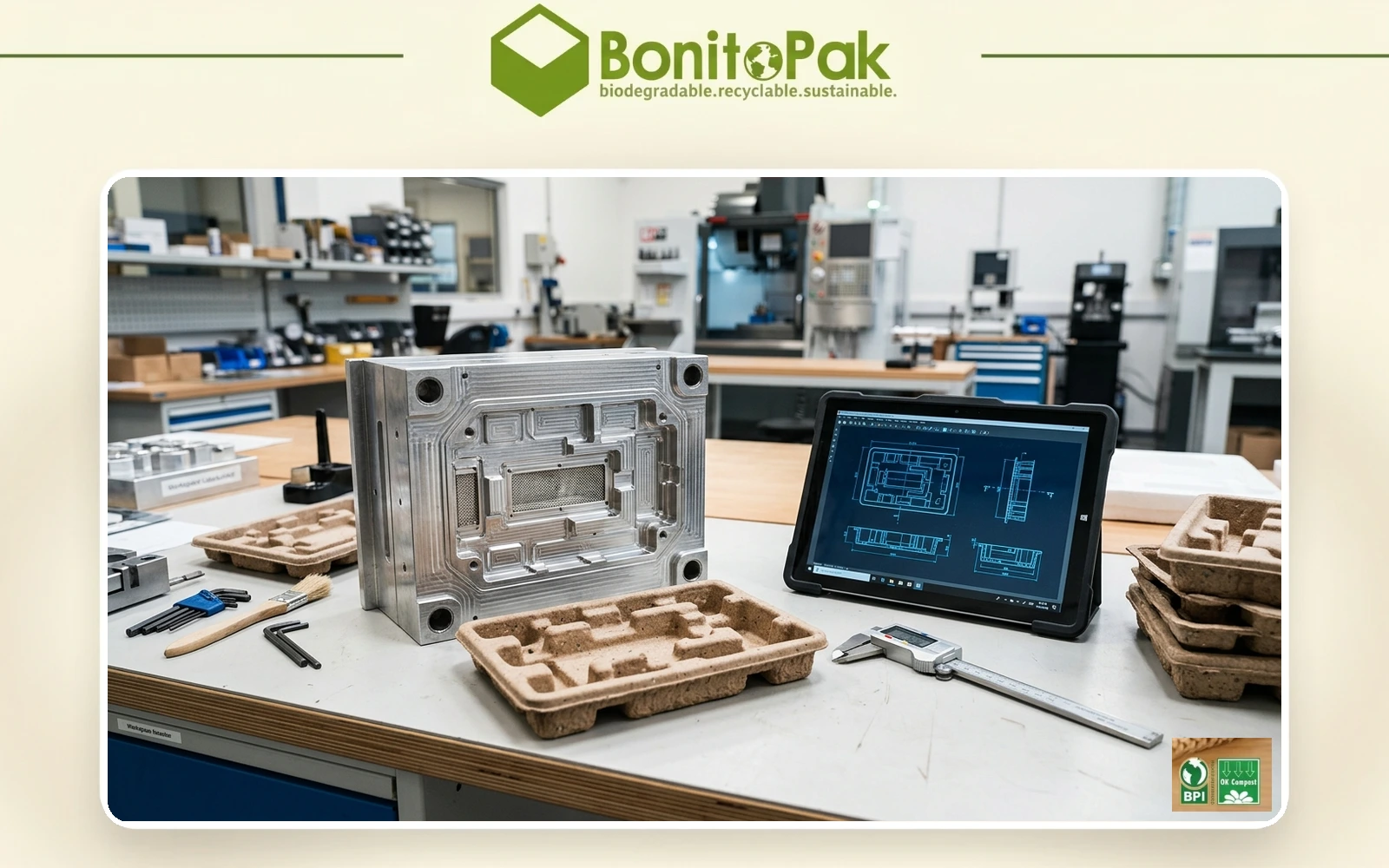
A good supplier handling a plastic to molded pulp conversion will redesign the geometry to suit the material: more generous draft angles, radiused corners, ribs for stiffness, and a wall thickness matched to the load. The finished part protects as well or better. It just does not look like a fiber copy of a plastic tray.
Step 3: Test Against Your Current Pack
Test the new pack and the old pack together, in the same conditions, so you have a comparison rather than an impression.
Run these on the sample:
- Fit check with real product, including the largest units in your tolerance range.
- اختبار السقوط at your normal case weight and typical drop heights.
- Vibration testing, or a real run over your actual delivery route.
- Stack and compression testing at full pallet height.
- Climate exposure, especially if your product moves through cold storage or humid warehouses. Fiber absorbs moisture that plastic does not.
- A line trial, which is the one people skip.
That last point is where most disruption actually comes from. Fiber trays nest differently, weigh differently, and de-nest differently from plastic. If your line has automated de-nesting, vacuum pick-up, or optical sensors calibrated to a glossy surface, all three may need adjusting.
Book your line trial before you approve production tooling, not after.
Ask your supplier what they check on their own side too. Weight per part, wall consistency, and moisture content all affect how a tray behaves on your line, and our ضمان الجودة page sets out how those checks are structured.
Step 4: Plan the Transition Itself
This is the part that protects your supply chain.
Run Both Packs in Parallel
Do not cut over on a single date. Keep buying your existing pack while the first fiber order is produced and shipped, and run both for at least one full order cycle. Dual running costs a little in inventory and saves a great deal in risk.
Time It Around Your Stock
Order the fiber pack when you still have 10 to 12 weeks of old stock remaining. A first custom order typically takes about 10 to 14 weeks from brief to delivered pallets in the US, covering design, tooling, sampling, production, and ocean freight.
Brief Everyone Who Touches the Pack
| Team | What they need to know |
|---|---|
| Warehouse | New pallet counts, nesting heights, and storage footprint |
| Pack line operators | Changes in handling, de-nesting, and feed rate |
| Quality | New accept and reject criteria, since fiber has different cosmetic norms |
| Customer service | What to tell customers who notice the change |
| Marketing | Whether the change is announced, and what claims are allowed |
| الامتثال | Any labeling updates for recyclability or compostability |
The quality point deserves attention. Fiber has natural color variation and visible texture. If your inspectors apply plastic standards, they will reject good product in the first weeks. Agree on the cosmetic specification before the first container lands.
Step 5: Scale by Waves
The rest of switching to molded pulp packaging is repetition. Once the pilot SKU ships cleanly for a full cycle, move in waves rather than all at once.
- Wave 1: The pilot SKU, at full volume.
- Wave 2: SKUs with similar geometry, which can often share tooling logic and lessons.
- Wave 3: High-volume lines, once the process is routine.
- Wave 4: The difficult cases, including fragile items and anything needing transparency.
Grouping SKUs by shape rather than by sales rank usually saves tooling money, because similar parts can sometimes be run from related tools or at least specified together.
What Usually Goes Wrong
| Problem | Cause | Prevention |
|---|---|---|
| Trays will not de-nest on the line | No line trial before production | Trial the sample on the real line |
| Cosmetic rejections spike | Plastic standards applied to fiber | Write a fiber-specific cosmetic spec |
| Product damage rises | Geometry copied from plastic | Redesign for fiber, then drop test |
| Trays soften in storage | Humidity or wash-down exposure | Test climate conditions before committing |
| Stock gap at changeover | Cutover planned too tight | Dual run, and order 10 to 12 weeks early |
| Pallet counts change unexpectedly | Nesting height not checked | Confirm nesting and case fit at sample stage |
None of these are exotic. They are the same six issues, in roughly the same order, on most transitions.
What You Gain Beyond Compliance
Once the switch settles, the operational benefits tend to show up quietly:
- Freight efficiency, since fiber trays nest tightly and cut shipping volume compared with rigid non-nesting packs.
- Storage savings from the same nesting behavior.
- Simpler disposal for your customer, which reduces support questions.
- Branding options that plastic does not offer, including embossed logos and color mixed into the pulp rather than printed on.
- Lower EPR exposure where fees are weighted by material.
Our article on why molded pulp suits beauty bottle packaging shows how that plays out in one consumer category.
A Realistic Transition Schedule
For a single pilot SKU, working backwards from your cutover date:
| Weeks before cutover | Activity |
|---|---|
| 16 to 14 | Choose the SKU, brief the supplier, send product samples |
| 14 to 12 | Design review, process decision, drawing approval |
| 12 to 10 | Sample tooling and sample production |
| 10 to 8 | Testing, including the line trial, plus one revision round |
| 8 to 7 | Production tooling and pre-production approval |
| 7 to 4 | Mass production and inspection |
| 4 to 1 | Freight, customs, and inland delivery |
| 1 to 0 | Dual running begins, teams briefed |
Add two weeks if you ship to the US East Coast, and add the full closure length if a Chinese holiday period falls inside the window.
Making the Change Stick
A sustainable packaging transition succeeds on sequence, not on enthusiasm. One SKU, tested honestly against the pack it replaces, with both running side by side until the numbers agree. Everything after that is repetition.
The teams that get into trouble are the ones that treat fiber as a drop-in substitute for plastic. It is a different material with different strengths, and it rewards a redesign rather than a copy.
في بونيتوباك, we have moved more than 500 brands from plastic and foam to fiber formats. Our خدمة مخصصة team handles the redesign, our mold design and tooling team cuts the molds in house, and orders start at 1,000 pieces. Send us the pack you want to replace, along with the product itself, and we will tell you what changes and what does not.
الأسئلة الشائعة
Q: How long does it take to replace foam packaging with molded pulp? A: Plan on about 10 to 14 weeks for a first custom order, including design, tooling, sampling, production, and ocean freight to the US. Run both packs in parallel for at least one order cycle after that.
Q: Will molded pulp protect my product as well as foam? A: In most cases, yes, provided the part is redesigned for fiber rather than copied from the foam shape. Dry pressed fiber walls cushion impact well. Drop test both packs together before committing to the change.
Q: Can I use my existing pack line with fiber trays? A: Usually, with adjustments. Fiber nests, weighs, and de-nests differently from plastic, and optical sensors tuned for glossy surfaces may need recalibrating. Book a line trial with sample trays before approving production tooling.
Q: Do I have to change every SKU at once? A: No, and you should not. Convert one pilot SKU, prove it through a full order cycle, then scale in waves grouped by shape. Phasing keeps a single mistake from affecting your whole catalog.
Q: Is molded pulp always cheaper than plastic? A: Not always on unit price. The savings usually come from freight, storage, and packaging fees under state EPR laws. Compare total landed cost plus compliance exposure rather than the per-piece quote alone.
About the author: Leo Chan is the founder of BonitoPak and has spent more than 20 years in molded pulp packaging, working with over 500 brands moving from plastic and foam to fiber-based formats. BonitoPak manufactures molded pulp packaging at its facility in Chashan Town, Dongguan, Guangdong, running both wet pressing and dry pressing lines with in-house mold design and tooling. This article is general information, not legal or compliance advice.



 Arabic
  English
  German
  Spanish
  French
  Russian
  Japanese
  Portuguese