 تخطي إلى المحتوى
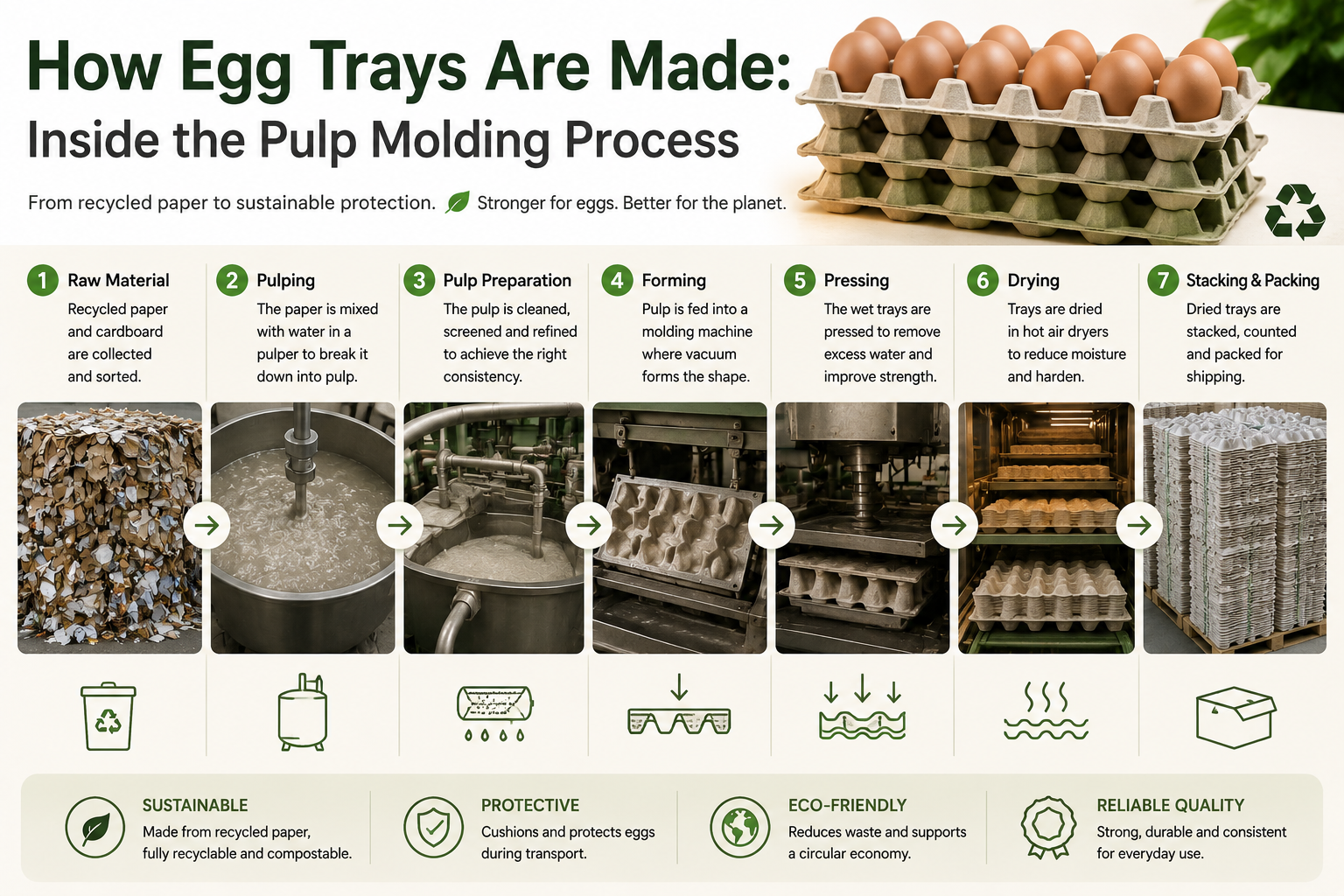
باختصار: Egg trays are made by pulping recycled paper or plant fiber into a water slurry, drawing it onto a shaped screen mold under vacuum, pressing out water, and drying the formed part. The whole cycle runs in minutes. This guide covers each stage, the equipment involved, why cell geometry matters more than most buyers realize, and what separates a good tray from a cheap one.
An egg tray looks like the simplest possible piece of packaging. Gray, rough, disposable, unremarkable.
It is also one of the few packaging formats that has survived essentially unchanged for over a century, because the design solved its problem completely. Individual cells isolate each egg. Tapered walls absorb shock through controlled deformation. Nesting geometry means empty trays ship at a fraction of their loaded volume.
What has changed is the manufacturing. Modern pulp molding lines produce trays at rates that would have been unimaginable to the format’s inventors, and the difference between a tray that protects eggs and one that lets them break comes down to details invisible in the finished product.
This is what happens between recycled paper and a finished egg tray.
What Raw Materials Go Into an Egg Tray?
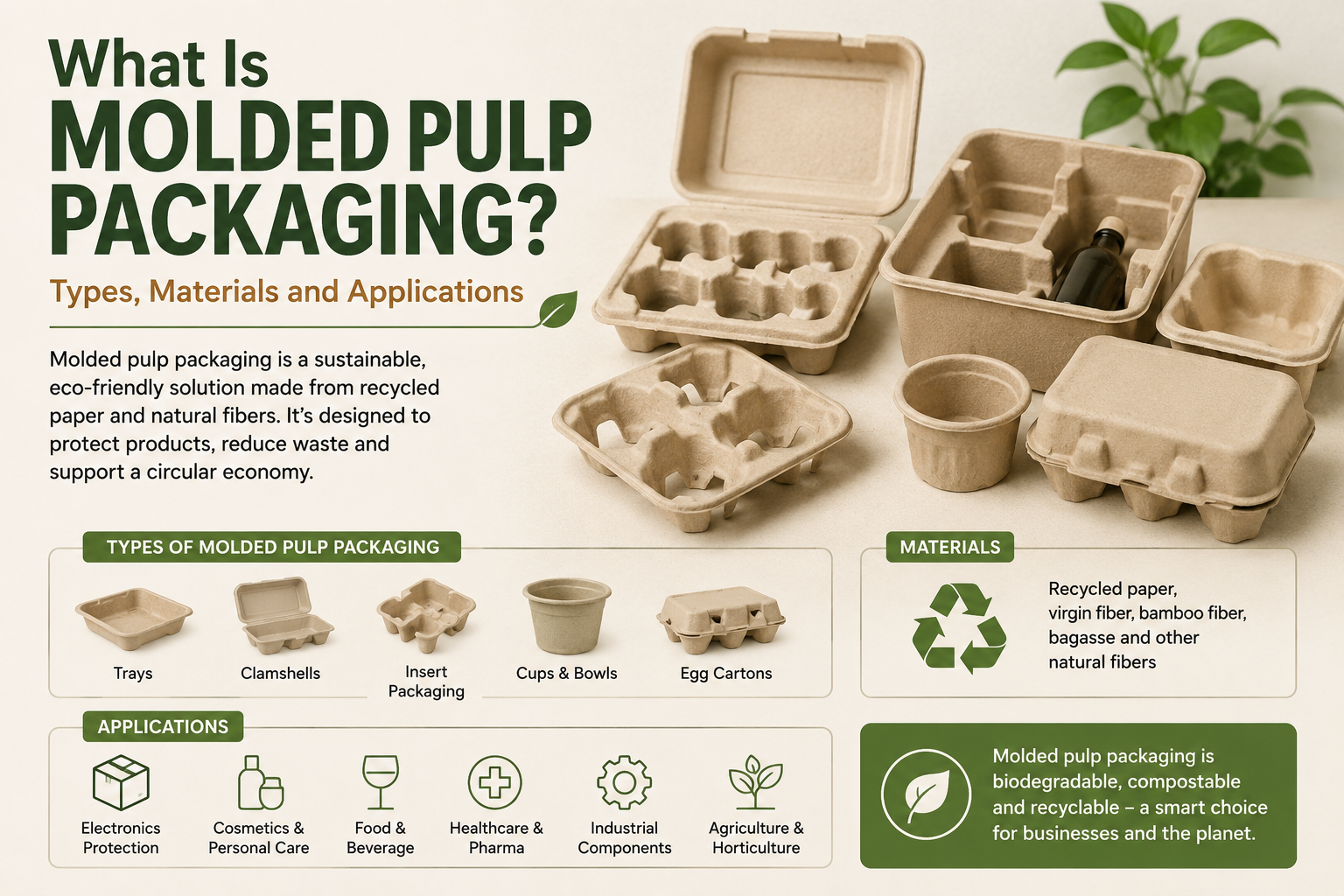
Egg trays are made from recycled paper, recycled corrugated board, or virgin plant fiber including sugarcane bagasse and bamboo. Most commodity egg trays use recycled input because surface refinement is not the objective and the cost difference is significant.
| Input | المصدر | التكلفة | السطح | Typical use |
| الورق المعاد تدويره | Mixed recovered paper | الأدنى | Rough, gray | Commodity flats, distribution |
| Recycled corrugated | Post-industrial and post-consumer board | الأدنى | Rough, gray | Commodity flats |
| تفل قصب السكر | المخلفات الناتجة عن سحق قصب السكر | متوسط | Smoother | Premium retail, colored trays |
| خيزران | محصول سريع النمو | متوسط | جيد | Sustainability positioning |
Bagasse deserves a note. It is the fibrous residue left after sugarcane is crushed for juice, a waste stream historically burned in the field. Using it for packaging diverts an existing byproduct rather than consuming a new crop.
There is an honest limitation with recycled input worth stating. Paper fiber shortens each time it passes through the recycling process, and egg trays are typically made from fiber that has already been recycled several times. That means the tray sits near the end of the fiber lifecycle rather than the start, and may not be reprocessable into new paper indefinitely. Composting resolves it, since short fiber composts exactly as well as long fiber. The full recycling and composting picture, including certification, is covered in are egg trays recyclable.
What Are the Stages of Egg Tray Production?
Egg tray manufacturing runs through five stages: pulping, forming, pressing, drying and stacking. The الرابطة الدولية للألياف المقولبة classifies egg trays as Type 2 transfer molded fiber, the most common molded fiber category in production worldwide. The full cycle takes minutes rather than hours, and most of the elapsed time is drying.
Stage 1: Pulping. Raw material is soaked in water and agitated until the fiber separates into a slurry of the correct consistency. Excess water is returned to the system rather than discharged, which is why modern pulp molding lines are relatively water-efficient despite starting from a water-based process. Pigment is introduced at this stage if the tray is being colored, which is why in-pulp color goes all the way through the finished wall.
Stage 2: Forming. A shaped mesh tool is lowered into the slurry tank. Vacuum draws water through the mesh, and fiber accumulates on the tool surface, building up layer by layer until the target wall thickness is reached. The vacuum does double duty: it deposits the fiber and removes most of the water mechanically, which reduces the energy needed later for drying.
Stage 3: Pressing. Upper and lower tools close on the formed part. In dry pressing this compacts the part and expels more water before it moves to drying. In wet pressing the tools are heated, and the part cures inside the mold rather than moving to a separate drying stage at all.
Stage 4: Drying. Dry pressed parts transfer to an oven or open drying racks. This is the slowest stage and the biggest energy consumer in the process. Wet pressed parts skip it entirely.
Stage 5: Stacking and finishing. Finished trays are stacked, counted and packed. Nesting geometry means a stack of empty trays occupies a fraction of the volume of the same trays loaded with eggs.
| المرحلة | What happens | Key variable |
| اللب | Fiber separated in water, pigment added if colored | Slurry consistency |
| التشكيل | Vacuum draws fiber onto mesh tool | Dwell time sets wall thickness |
| الضغط على | Tools close, water expelled | Pressure and, in wet press, heat |
| التجفيف | Oven or open air, or cure-in-mold | Time and temperature |
| Stacking | Count, nest, pack | Nesting geometry |
What Equipment Does an Egg Tray Line Use?
A complete egg tray production line includes a pulping system, a forming machine with molds, a drying system, and stacking equipment. Line configurations range from manual and semi-automatic setups to fully automatic rotary systems.
The forming machine is the heart of the line and the main determinant of output rate. Rotary forming machines carry multiple mold sets on a drum, forming continuously as the drum turns, which gives much higher throughput than reciprocating machines that form one set at a time.
| Equipment | الوظيفة | Variable that matters |
| Pulping system | Breaks material into slurry | Throughput matched to former |
| Forming machine | Vacuum forms parts on mesh molds | Cavity count, cycle rate |
| Molds and tooling | Define cell geometry | Cavity count, mesh condition |
| Drying system | Removes remaining moisture | Energy efficiency, throughput |
| Stacker | Counts and nests output | Automation level |
| Washing equipment | Cleans molds and screens | Affects surface consistency |
Mold condition is an underrated variable. The mesh surface fouls over time as fine fiber embeds in it, which changes vacuum distribution and produces trays with uneven wall thickness. Lines running proper mold washing cycles produce more consistent trays than lines that do not, and the difference shows up as breakage rates rather than as anything visible in the tray.
Why Does Egg Tray Cell Geometry Matter?
Cell depth, taper and wall thickness determine whether an egg is held securely or free to move, and movement against a rigid cell wall is what cracks shells in transit. A tray cut to a generic profile holds one egg grade well and adjacent grades badly.
This is the part buyers routinely underestimate.
Cell depth sets how much of the egg sits below the tray surface. Too shallow and the egg protrudes, taking impact directly when trays stack. Too deep and the egg sits loose in the base.
Taper angle decides whether the egg contacts the cell wall around its circumference or only at a narrow band. Correct taper distributes load. Incorrect taper concentrates it at a single point, which is where shells crack.
سماكة الجدار governs how the cell deforms under impact. A thicker wall resists more but transmits more shock. A thinner wall absorbs through deformation but bottoms out sooner under heavy loads.
Nesting depth determines how empty trays stack for return shipping, and how loaded trays stack without the upper tray bearing on the eggs below.
The practical consequence: farms packing mixed grades on a single tray profile see breakage cluster in specific size bands. It reads as a handling problem and it is actually a geometry mismatch.
| نوع البيض | Cell requirement | الملاحظات |
| Chicken, standard grades | Standard profile per grade | Large and jumbo need different depth |
| البطة | Larger, deeper cell | Heavier egg, more shell mass |
| Quail | Much shallower, tighter | Cannot use any chicken profile |
| أوزة | Largest cell, deep | Specialist tooling |
| تركيا | Between chicken and goose | Elongated profile |
| Bantam | Smaller than standard chicken | Often mistaken for standard |
How Long Does It Take to Make an Egg Tray?
A single egg tray forms in minutes, not hours. The forming cycle itself takes seconds to a minute depending on wall thickness and machine type, but drying dominates total elapsed time in dry pressed production. Wet pressed parts cure inside heated tooling and skip separate drying entirely.
Thicker walls take longer at both ends: longer forming dwell to build up the fiber, and longer drying to remove the water that fiber holds. That is one reason thick wall trays cost more to run despite using cheaper material.
For buyers, the number that matters is not cycle time but the tooling timeline before production starts:
| المرحلة | Turnaround |
| 3D drawing from your samples or file | 2 days |
| Sample mold cut and prototype parts | 7 أيام |
| Production mold cut after approval | 8 أيام |
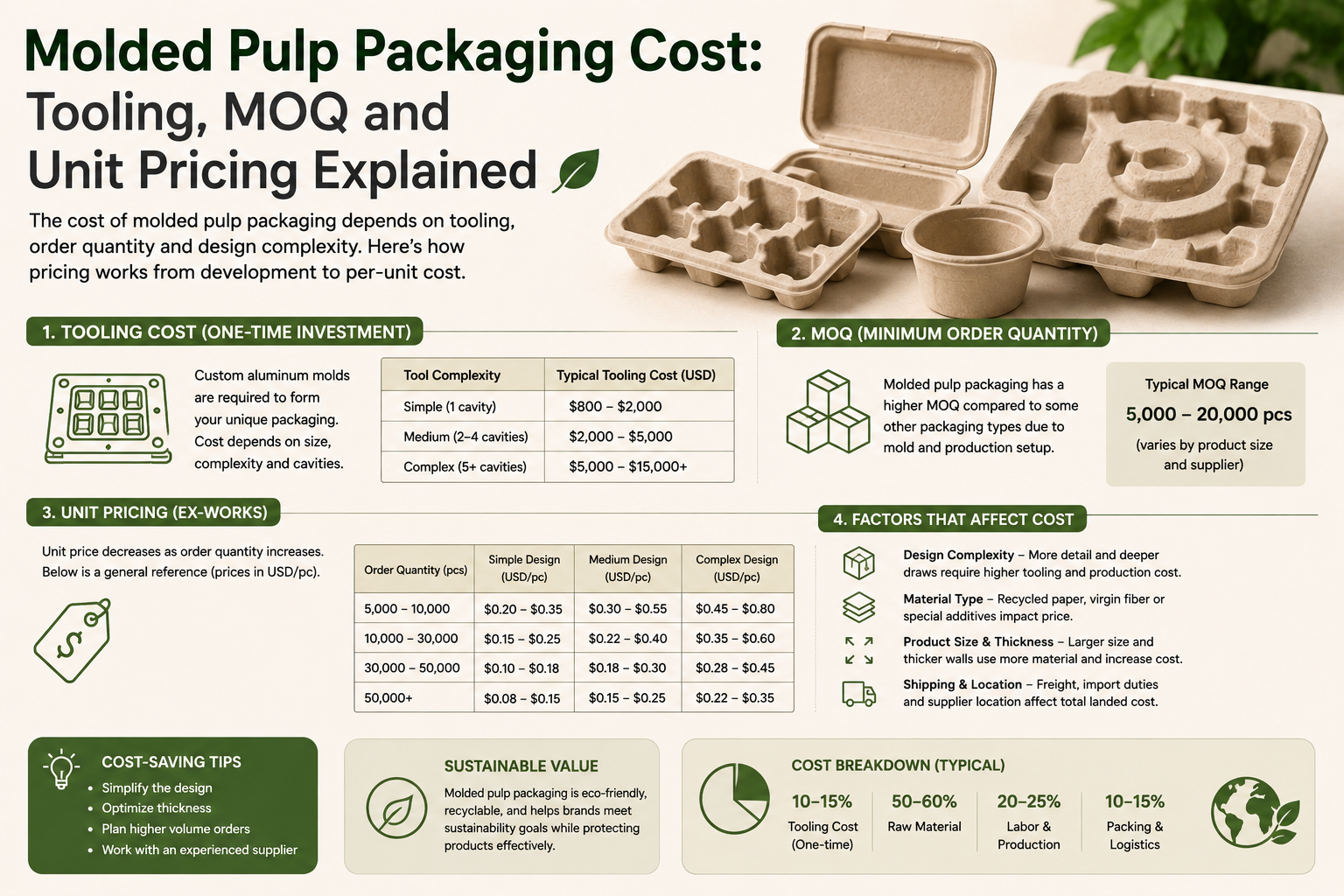
The two-stage tooling sequence exists because a production mold that needs geometry changes is scrapped rather than modified. Revisions absorbed at the sample stage cost a fraction of one caught afterward. Buyers who push straight to production tooling are the ones who most often pay for two molds. How that tooling charge sits against unit price across an order is explained in تكلفة التغليف المصنوع من اللب المقولب.
What Separates a Good Egg Tray From a Cheap One?
Consistent wall thickness, correct cell geometry for the egg grade, and clean mold surfaces. None of these are visible in a finished tray, which is exactly why cheap trays exist as a category.
What to check when evaluating samples:
Wall thickness consistency across the tray. Hold it to light. Thin patches indicate uneven vacuum distribution, usually from fouled mesh. Those patches are where the tray fails.
Cell fit against your actual eggs. Not against a spec sheet. Place your eggs in the sample and check they sit level and contact the cell wall around the circumference rather than at one point.
Nesting. Stack ten empties and check they nest cleanly without wedging. Wedged trays jam automated destacking equipment.
Stacking loaded. Two loaded trays stacked should have the upper tray bearing on the tray rim, not on the eggs below.
Edge integrity. Run a finger along the outer rim. Ragged fiber indicates poor mold condition or insufficient press pressure.
Drop test with product. Load the tray and drop it from the height it will realistically experience. Breakage patterns tell you where the geometry is wrong.
That last one is worth doing properly rather than casually. A tray that passes a bare drop test can still fail loaded, because the load changes the deformation behavior entirely.
الخاتمة
Three takeaways.
Cell geometry does the work, not material. Depth, taper and wall thickness decide whether eggs survive transit. A tray cut for the wrong grade produces breakage that looks like a handling problem.
Consistency separates good production from cheap production. Uneven wall thickness from fouled molds is invisible in a finished tray and shows up as breakage rates in the field.
Test with your actual eggs before committing tooling. A sample that fits a spec sheet may not fit your grade, and the sample mold stage exists precisely so you can find that out cheaply.
If you are specifying egg trays, send physical egg samples or your grade specification along with count per tray and annual volume. We design the cell profile around your eggs rather than pulling a standard profile off a shelf.
الأسئلة الشائعة
What are the stages of egg tray manufacturing?
Egg tray production runs through five stages: pulping, forming, pressing, drying and stacking, with the full cycle taking minutes rather than hours. Pulping soaks and agitates raw material until fiber separates into a slurry of the right consistency, returning excess water to the system rather than discharging it, and this is where pigment is added if the tray is being colored. Forming lowers a shaped mesh tool into the slurry while vacuum draws water through the mesh and fiber accumulates on the tool surface until target wall thickness is reached. Pressing closes upper and lower tools to compact the part and expel more water, drying removes the remaining moisture in an oven or on open racks, and stacking counts and nests the finished output.
What raw materials are egg trays made from?
Most commodity egg trays are made from recycled paper or recycled corrugated board, because surface refinement is not the objective for a distribution flat and the cost difference against virgin fiber is significant. Premium and colored egg trays more often use sugarcane bagasse, the fibrous residue left after cane is crushed for juice, or bamboo fiber, both of which give smoother surfaces and better color acceptance. There is an honest limitation with recycled input worth knowing: paper fiber shortens each time it goes through the recycling process, and egg trays are typically made from fiber that has already been recycled several times, so they sit near the end of the fiber lifecycle rather than the start. Composting resolves that entirely, since short fiber composts exactly as well as long fiber.
Why does egg tray cell geometry matter so much?
Cell depth, taper angle and wall thickness together determine whether an egg is held securely or left free to move, and movement against a rigid cell wall is what cracks shells between the packing line and the shelf. Cell depth that is too shallow leaves the egg protruding so it takes impact directly when trays stack, while excessive depth leaves it loose in the base. Taper angle decides whether the egg contacts the cell wall around its full circumference, distributing load, or only at a narrow band that concentrates it into a single crack point. The practical consequence is that farms packing mixed grades on one tray profile see breakage cluster in specific size bands, which reads as a handling problem but is actually a geometry mismatch.
Can the same egg tray hold different bird types?
No, and attempting it is a common source of breakage and product loss. Chicken trays are cut to standard grade profiles, but duck eggs need a larger and deeper cell to accommodate heavier eggs with more shell mass, while quail eggs need a far shallower and tighter cell that no chicken profile can approximate. Goose eggs require the largest cells with specialist tooling, turkey eggs need an elongated profile sitting between chicken and goose, and bantam eggs are smaller than standard chicken and are often mistakenly packed in standard trays. Even within chicken production, large and jumbo grades need different cell depths, so specify both bird type and grade at the quote stage rather than after tooling is cut.
How long does it take to produce egg trays?
The forming cycle itself takes seconds to about a minute depending on wall thickness and machine type, but in dry pressed production drying dominates total elapsed time and is the biggest energy consumer in the process. Thicker walls extend both ends of the cycle, requiring longer forming dwell to build up fiber and longer drying to remove the water that fiber holds, which is part of why thick wall trays cost more to run despite using cheaper material. Wet pressed parts cure inside heated tooling and skip separate drying entirely. For buyers the more relevant timeline is tooling: 2 days for a 3D drawing from your samples, 7 days for a sample mold and prototype parts, and 8 days for the production mold once geometry is approved.
How do I tell a good egg tray from a cheap one?
Three things separate them and none are visible at a glance: consistent wall thickness, correct cell geometry for your egg grade, and clean mold surfaces during production. Hold a sample to light and look for thin patches, which indicate uneven vacuum distribution from fouled mesh screens and mark exactly where the tray will fail. Place your actual eggs in the sample rather than trusting a spec sheet, checking they sit level and contact the cell wall around the full circumference rather than at one point, then stack ten empties to confirm they nest cleanly without wedging, since wedged trays jam automated destacking equipment. Finally run a loaded drop test from a realistic height, because a tray that passes a bare drop test can still fail loaded when the added mass changes deformation behavior entirely.


 Arabic
  English
  German
  Spanish
  French
  Russian
  Japanese
  Portuguese